
 Book a Demo


How Capital Finalization Reshapes Balance-Sheet Strategy
How Does Basel IV Actually Impact Balance Sheet Management?
Basel IV (the finalization of Basel III) does not introduce new rules for Asset and Liability Management. But its indirect impact on ALM is profound: by tightening capital requirements and constraining internal models, it fundamentally reshapes the balance sheets that ALM must manage.
Measures such as the output floor and revised market-risk standards are making capital a binding constraint for many banks. This creates a forcing event: business models, product mix, and balance sheet strategies must adapt to remain competitive and compliant.
Over time, these shifts demand more forward-looking balance sheet projections and tighter integration across ALM, Treasury, and Capital Planning.
This whitepaper translates Basel IV from a regulatory concept into its practical consequences for balance sheet strategy and the evolving role of ALM within it.
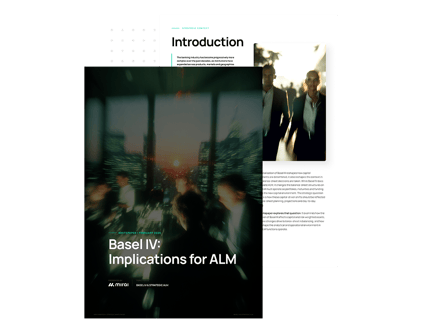
What This Whitepaper Explores
Drawing directly from expert insight, this publication translates Basel IV from a regulatory concept into its practical consequences for balance-sheet strategy and the evolving role of ALM.
Inside, you will learn:
-
Why Basel IV is better understood as the final stage of Basel III
-
How RWA changes and the output floor affect lending and portfolio mix
-
How FRTB influences trading portfolios and hedging strategies
-
How changes in capital requirements shape balance-sheet projections and planning
-
The growing importance of data, governance, and integrated ALM frameworks


Key Findings
What Are the Key Findings on Basel IV and ALM?
- Basel IV is a constraint on the balance sheet, not on ALM directly. Capital finalization reshapes which assets are economically attractive, forcing portfolio rebalancing that ALM must then manage for interest rate and liquidity risk.
- The output floor changes the binding capital constraint over time. As it phases in, the effective capital measure shifts from internal model outputs to standardized levels—ALM projections must reflect when and where this transition occurs.
- Static balance sheet projections are no longer fit for purpose. NII, EVE, LCR, and NSFR metrics only remain coherent when measured on the balance sheet the bank is likely to hold — not one that assumes stable composition.
- Data fragmentation is the primary operational risk. Banks still relying on aggregated data and spreadsheet-based models cannot support the granular, multi-dimensional scenario analysis Basel IV demands. One Mirai platform client runs 60 forecasts on 2 million transactions in 30 minutes.
- Governance gaps become strategic gaps. When ALM, capital planning, and stress testing project the balance sheet differently, strategic decisions rest on inconsistent foundations — a risk that Basel IV's tighter constraints make harder to absorb.
Who Should Read This?
This whitepaper is designed for professionals navigating the strategic and operational implications of Basel IV, including:
ALCO members and senior management
Treasury and ALM professionals
Risk and finance teams
Banking regulators and supervisors
Anyone involved in balance-sheet strategy will find a clear and practical perspective on how Basel IV reshapes the operating environment.