Book a Demo





Every Supervisory Review and Evaluation Process (SREP) cycle forces banks to take a hard look at their balance-sheet resilience, governance maturity, and long-term sustainability. The European Central Bank (ECB) has recently published its 2025 SREP, in which these aspects stand out. It arrives at a moment of tightening margins, slowing net interest income (NII), and higher expectations around risk data, model discipline, and stress testing.
Below we recap the 8 insights from the 2025 SREP that matter most for European banks—along with practical actions to improve readiness for the 2026 cycle.
Audio Article
This year, capital requirements and guidance remain broadly stable, but supervisors have sharpened their scrutiny in areas such as leverage risk, NPE provisioning, and the quality of internal processes behind ICAAP, ILAAP, and planning exercises.
For ALM, risk, and finance teams, the message is clear: the next phase of prudential supervision will reward institutions that can demonstrate forward-looking, data-driven, and fully integrated balance-sheet management.
Let us therefore review the main insights the ECB gives in its latest SREP.
The Supervisory Review and Evaluation Process (SREP) is the European Central Bank's annual assessment of banks' governance, capital adequacy, liquidity, risk management, and operational resilience. It identifies supervisory priorities and helps ensure that institutions maintain sound risk management practices and financial resilience.
8 Insights from the 2025 SREP that Matter Most for European Banks
1. Capital Requirements Remain Stable, but Supervisors Expect Proactive Preparedness
The ECB reports that overall capital requirements and guidance for 2026 stand at 15.6% of RWA, broadly in line with last year’s levels. Stability, however, should not be misinterpreted as leniency. Banks are expected to maintain capital positions that remain comfortably above regulatory minima even under adverse conditions.
The 2025 results highlight:
- More consistent capital planning expectations, especially around scenario integration and strategic alignment.
- Focus on the quality of capital projections, rather than the quantity of capital itself.
- Rising supervisory skepticism toward institutions relying on favorable rate environments to sustain profitability and buffers.
Implication: Banks must refine multi-year balance-sheet projections, integrate macro scenarios into capital pathways, and demonstrate clear governance over ICAAP and stress-testing frameworks.
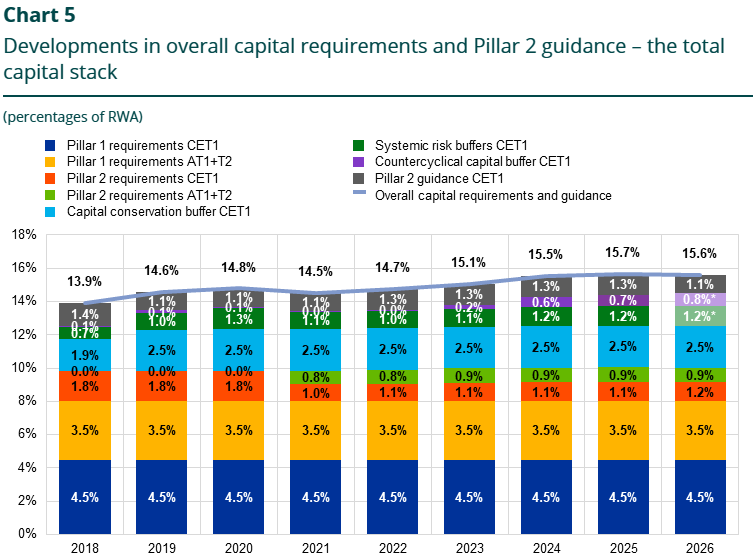
“Capital requirements remain broadly stable across the European banking sector, reinforcing that supervisory scrutiny now focuses less on absolute capital levels and more on the quality of forward-looking capital planning and scenario integration. Sources: ECB supervisory banking statistics and ECB SREP database.”
2. Leverage Ratio Add-Ons Signal Rising Attention to Back-Stop Leverage Risk
Several banks received 10–30 bps leverage-ratio Pillar 2 Requirements (P2R) add-ons, a signal that the ECB is tightening expectations around leverage risk as a structural safeguard.
The P2R indicates the additional capital a bank must hold to cover risks not fully captured under Pillar 1, which represents the minimum regulatory capital requirements set under the Basel framework and covers core risks such as credit, market, and operational risk. In this context, the add-ons' supervisory concerns that leverage exposure could become a vulnerability under stress.
Key drivers include:
- Balance-sheet expansion not matched by commensurate risk controls
- Business-model vulnerabilities amplified under stress
- Weaknesses in capital planning and leverage forecasting methodologies
These add-ons may be modest in magnitude, but they matter. They indicate that supervisors now expect banks to treat leverage risk with the same strategic attention as RWA-based capital assessments.
Implication: ALM and risk teams must enhance monitoring of leverage exposures, create early-warning indicators, and integrate leverage into long-term planning—not treat it as a side calculation.
3. NPE-Related Add-Ons Reveal Persistent Credit-Risk Sensitivities
Non-Performing Exposures (NPEs) refer to loans and other credit exposures where the borrower is unlikely to repay or is more than 90 days past due. They remain one of the most sensitive indicators of credit-risk deterioration in supervisory assessments.
Ten banks received NPE-related P2R add-ons in the 2025 SREP cycle. The average shortfall increased to 8 bps, up from 5 bps last year. While not dramatic, the trend signals the ECB’s continued vigilance around credit-quality deterioration.
Key themes:
- Supervisors expect faster progress in reducing legacy NPEs
- Forward-looking provisioning frameworks remain uneven
- Stress-test models still underestimate severe credit downturns
What does this mean for European banks?
For banks with stable credit-quality metrics, this is a reminder to keep provisioning frameworks sharp and scenario-driven. For banks with pockets of vulnerability, the SREP sends a clear message that remediation must accelerate.
Implication: Credit-risk integration within ICAAP and ALM frameworks is not only mandatory. Banks need consistent bottom-up data, centralized reporting workflows, and calibrated stress-testing libraries to demonstrate resilience.
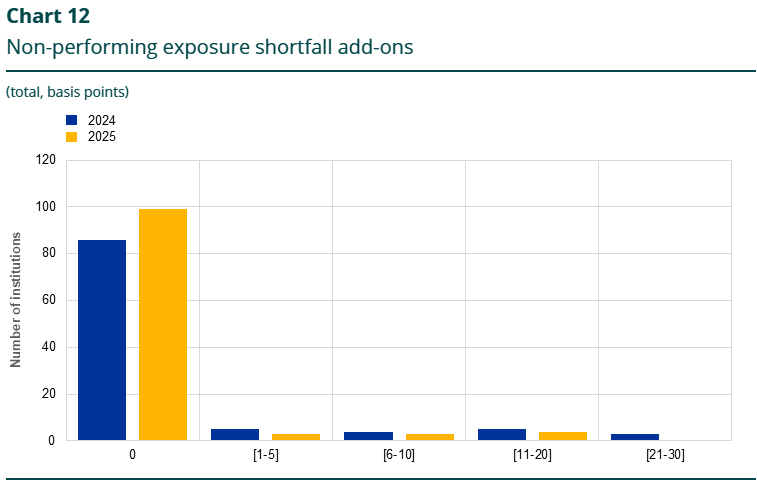
Source: ECB internal calculations.
4. Governance and Risk-Management Weaknesses Continue to Drive Supervisory Intervention
Despite progress in several areas, the SREP again highlights recurring weaknesses in internal governance, underscoring that structural issues persist beneath otherwise stable risk metrics. These weaknesses are particularly visible in:
- Management-body oversight and decision-making
- Risk culture and accountability frameworks
- Risk-data aggregation and reporting (RDARR)
- Consistency of internal-control functions
- Documentation quality in ICAAP and ILAAP submissions
Building on these observations, supervisors are increasingly clear about what they expect effective governance to look like in practice. Banks must now demonstrate:
- Strong analytical lineage from data to models to decisions
- Clear validation and governance of assumptions
- Direct board engagement in risk discussions
- Integrated reporting across risk, finance, and treasury
While governance shortcomings may not, on their own, trigger substantial capital increases, they consistently contribute to P2R add-ons when combined with weaknesses in risk management, modeling capabilities, or data governance. This pattern has become one of the most reliable signals in recent SREP cycles.
Implication: Banks with fragmented data environments or siloed risk frameworks must prioritize governance enhancements ahead of the 2026 cycle. Mature reporting architecture and automated controls now carry strategic weight, signaling to supervisors that the institution can manage complexity with discipline.
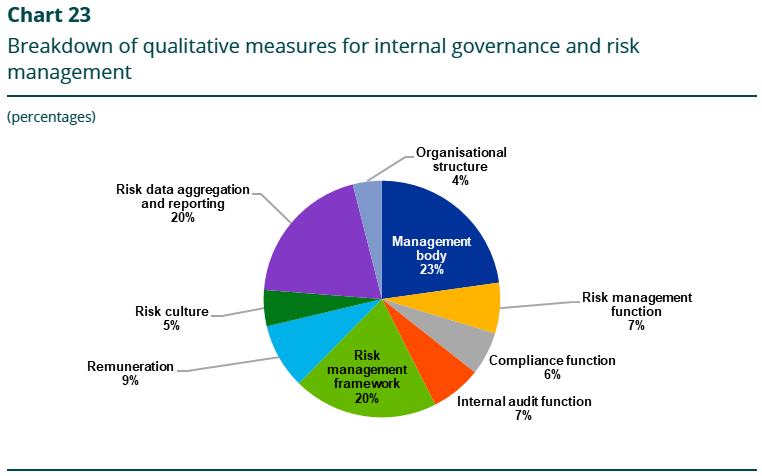
“Supervisors increasingly differentiate banks based on the sustainability of their business models. The distribution highlights where vulnerabilities concentrate—particularly reliance on interest margins, funding sensitivities, and insufficient diversification of revenues. Source: ECB, Chart 23, Breakdown of qualitative measures for internal governance and risk management.”
5. Profitability Is Strong—But Sustainability Concerns Remain
Banks posted solid profitability with ROE at 9.5% in 2024, rising to 10.1% in Q2 2025, accompanied by an improved cost-to-income ratio of 54.9%. Yet the ECB notes several structural concerns:
- NII growth is slowing as interest rates stabilize downward
- Funding costs are increasing
- Competition for deposits is intensifying
- Market-based income remains volatile
- Operational and IT costs continue to rise
Despite positive headline figures, supervisors increasingly question whether banks can maintain profitability without relying on short-term rate tailwinds. The focus has shifted from cyclical gains to structural sustainability.
Implication: Banks should enhance NII modeling capabilities, strengthen ALM analytics, and diversify revenue streams. The long-term sustainability of earnings is becoming a supervisory score on its own.
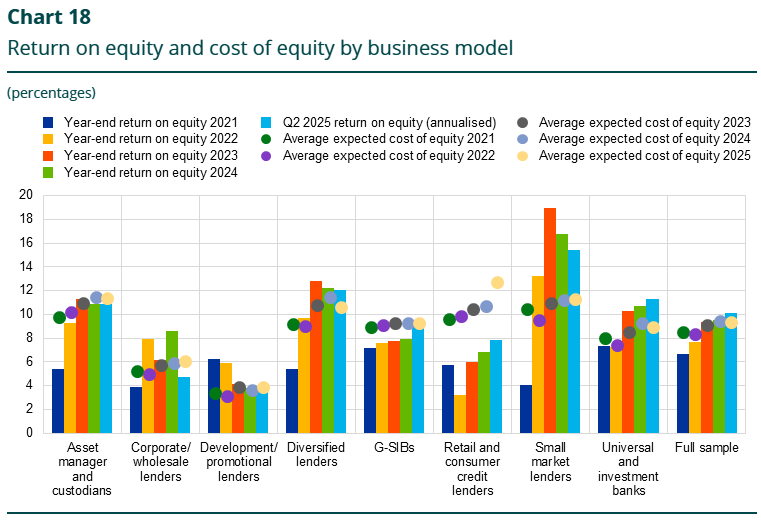
“Return on equity across bank business models – highlighting profitability trends and structural sustainability concerns. Source: ECB, Chart 18, 2025 SREP Aggregated Results.”
6. Business-Model Scores Improved—But Supervisors Are Not Fully Convinced
Following profitability and governance assessments, the ECB is turning a closer eye to the sustainability of banks’ business models. While headline scores are improving, supervisors remain cautious about structural vulnerabilities that could undermine long-term resilience.
Business-model assessments continue to improve, with the average score rising to 2.4 (from 2.5) and 18% of banks receiving a better evaluation. Only 4% deteriorated.
While headline scores are improving, the ECB retains concerns around:
- Overreliance on interest margin
- Sensitivity to market and funding pressures
- Concentration risks
- Underdeveloped non-interest sources of income
- Weak alignment between strategic plans and balance-sheet execution
The ECB’s message is explicit: banks need business models capable of generating sustainable, shock-resistant returns.
Implication: ALM must play a central strategic role in aligning business-model ambitions with balance-sheet realities through scenario analysis, stress testing and structural risk monitoring.
Looking ahead, this focus naturally bridges to credit-risk management, where non-performing exposures and provisioning frameworks provide the next test of strategic resilience.
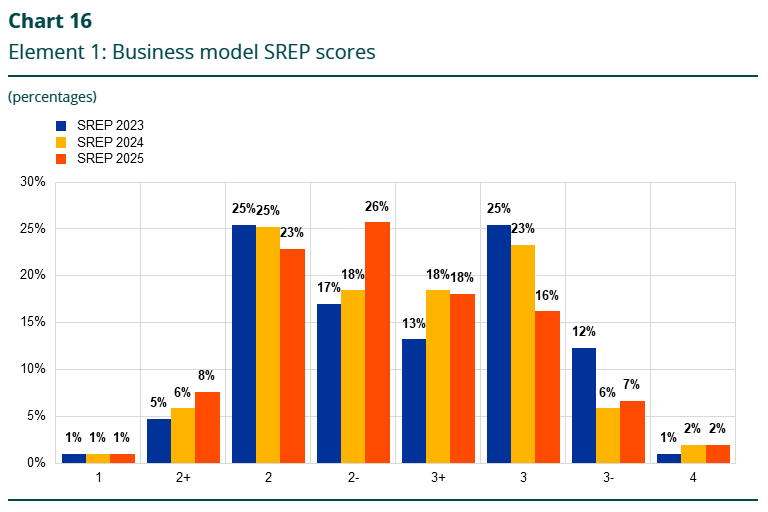
“Distribution of business-model SREP scores across European banks – highlighting areas of structural strength and concern. Source: ECB, Chart 16, 2025 SREP Aggregated Results.”
7. ALM Is Becoming Central to SREP Outcomes
Taken together, the SREP insights reveal a clear pattern: managing individual risks in isolation is no longer sufficient. Supervisors now expect banks to adopt a holistic approach where ALM and balance-sheet management link capital, liquidity, credit, and profitability considerations into a coherent, forward-looking framework.
Across governance, credit, leverage, profitability, and planning, one theme emerges: ALM evolves into a strategically critical element within the supervisory framework.
In practical terms, this means:
- Interest Rate Risk in the Banking Book (IRRBB) is now a core determinant of business-model sustainability.
- Structural liquidity expectations are increasing, with emphasis on behavioral modeling and deposit stability.
- Supervisors want banks to demonstrate multi-year balance-sheet resilience under multiple rate, liquidity and credit scenarios.
- Risk and finance teams must integrate ALM assumptions into capital planning and profitability forecasting.
Implication: Banks that treat ALM as a strategic lever—supported by reliable data, model discipline and advanced analytics—will be better positioned for future SREP cycles.
8. Data Quality and Reporting Discipline Matter More Than Ever
As ALM and strategic balance-sheet management gain prominence, the underlying quality of data and reporting frameworks becomes a decisive factor. Even the most sophisticated models and scenarios cannot drive resilience if data is fragmented, inconsistent, or poorly documented, which is why supervisors are placing renewed emphasis on reporting discipline.
The ECB continues to highlight issues with risk-data aggregation, reporting lineage and multi-source inconsistencies. These weaknesses often appear benign, but they correlate strongly with supervisory findings across all SREP elements.
Supervisors expect:
- A harmonized data architecture across risk, finance and treasury
- Strong data-validation rules and exception management
- Clear documentation supporting ICAAP/ILAAP and stress test calculations
- Real-time dashboards and traceability for critical indicators
- Evidence that management actively uses reported data to make decisions
Implication: Banks need to modernize data workflows—manually driven Excel processes or fragmented datasets create measurable SREP penalties.
Understanding these insights is critical. Banks must translate supervisory expectations into actionable priorities that align capital, ALM, governance, and data practices into a coherent, forward-looking framework. The next section outlines five practical areas where banks can act now to strengthen resilience ahead of the 2026 SREP cycle.
5 Practical Priorities Banks Should Be Doing Now
1. Strengthen Multi-Year Capital and Balance-Sheet Planning
- Integrate macroeconomic and rate scenarios into all forecasts
- Enhance documentation for ICAAP/ILAAP
- Build management dashboards that align capital, liquidity and profitability
2. Elevate ALM to a Strategic Function
- Improve IRRBB modeling and behavioral assumptions
- Enhance existing early-warning indicators for liquidity and leverage
- Connect ALM outputs with business-model decisions
3. Upgrade Risk-Data Architecture
- Automate data collection, aggregation, and validation
- Create a single data backbone for risk
- Ensure end-to-end traceability for supervisory processes
4. Address Governance Gaps Proactively
- Clarify risk ownership
- Strengthen board reporting
- Improve internal-control documentation and audit trails
5. Prepare for Margin Pressure and NII Decline
- Enhance NII modeling accuracy
- Build profitability forecasts for multiple rate paths
- Diversify income streams and optimize the liability stack
Implementing these priorities effectively requires the right tools and infrastructure. Modern risk technology platforms such as Mirai enable banks to centralize and aggregate risk data, integrate ALM processes, and manage regulatory reporting for IRRBB and liquidity, ensuring full traceability and consistency across reports. The ability to run large-scale scenarios enables institutions to generate robust calculations and actionable information required for the various annual reports they routinely prepare, such as ICAAP, ILAAP, Recovery and Resolution Plans, among others.
The 2025 SREP reinforces that banks relying on manual workflows or fragmented models will face increasing supervisory scrutiny, whereas those with integrated, traceable, and automated approaches are best positioned for success.
How Risk-Tech Solutions Help Banks Stay Ahead
Modern supervision demands integrated analytics, performance visibility, and robust scenario modeling. A platform like Mirai can help banks:
Project capital, liquidity and profitability under multiple scenarios
Monitor structural risks in real time
Centralise data across ALM, risk and finance
Build traceable reporting for boards and supervisors
The 2025 SREP underscores a structural truth: banks that rely on manual data work, isolated models or narrow planning frameworks will be increasingly out of position for the next cycle.
Future-Ready: Preparing for the Next SREP Cycle
The 2025 SREP is not a disruptive cycle, but it is a decisive one. Capital levels remain stable, but expectations around governance, data quality, planning maturity and long-term sustainability have solidified.
Banks that respond early will reduce capital pressure, improve supervisory dialogue and strengthen their competitive position.
Now is the time to elevate ALM, modernise risk data, and build integrated forecasting capabilities. The next SREP cycle will reward institutions capable of demonstrating not just resilience, but strategic clarity and data-driven execution.
Key Takeaways from 8 Insights from the 2025 SREP
- The 2025 SREP continues to prioritize governance, data quality, and risk management.
- Supervisors expect stronger integration between risk, finance, and treasury functions.
- Forward-looking stress testing remains a central supervisory expectation.
- Fragmented technology and inconsistent data continue to be significant supervisory concerns.
- Integrated Balance Sheet Management supports better governance, transparency, and regulatory readiness.
Ready to Turn SREP Insights into Action?
Book a demo of Mirai Platform today and see how integrated ALM, risk-data management, and scenario-based planning can strengthen your bank’s resilience and streamline supervisory compliance.
FAQ: 2025 SREP Findings for Banks
-
What are the main findings of the 2025 SREP?
The 2025 Supervisory Review and Evaluation Process (SREP) highlights continued supervisory focus on governance, data quality, risk modeling, stress testing, liquidity management, and technology integration. The findings emphasize that banks should address long-standing weaknesses while improving resilience and decision-making capabilities.
-
Why is data quality so important in the 2025 SREP?
The article explains that high-quality, consistent, and well-governed data is essential for reliable risk measurement, regulatory reporting, and supervisory decision-making. Poor data quality can undermine both internal management and regulatory confidence. -
What does the 2025 SREP say about stress testing?
The SREP reinforces that stress testing should be embedded in decision-making rather than treated solely as a regulatory exercise. Banks are expected to use forward-looking scenarios to assess resilience under changing economic and financial conditions. -
Why are integrated technology platforms becoming a supervisory priority?
The article notes that fragmented systems make it difficult to produce consistent risk metrics, respond efficiently to supervisory requests, and maintain effective governance. Integrated platforms help improve data consistency and support more reliable risk management. -
How should banks respond to the 2025 SREP findings?
Banks should strengthen governance, improve data quality, enhance risk modeling, integrate technology platforms, and ensure that treasury, finance, and risk teams operate using consistent information and forward-looking risk assessments.