
 Book a Demo


A complete reference for capital planning, regulatory implementation and cross-jurisdictional strategy, from the foundations of bank capital through to where the framework is heading next.
Capital Regulation Explained for Banking Professionals
Capital regulation sets out how much loss-absorbing capital a bank must hold against the risks it takes on. Basel III established a common global standard after the 2008 financial crisis, covering minimum capital ratios, leverage, buffers, resolution planning and supervisory review.
The problem practitioners face today is not the standard itself. It is that Basel III no longer produces the same capital framework everywhere. The EU, UK and US have each implemented the same rules on different timelines and with different calibrations, and that divergence is now the main operational challenge for any financial institution managing capital across borders.

This matters right now because implementation is entering its final phase. The output floor is phasing in across jurisdictions through 2028 to 2030. The UK's Basel 3.1 goes live in January 2027, and the US Basel Endgame remains unresolved after a materially lighter re-proposal in March 2026. Understanding where these frameworks converge and diverge has become essential for capital planning, not just for compliance.
This guide walks through the complete capital framework, from the economic case for holding capital through Basel III itself, and then into how the EU, the UK and the US have each implemented it differently.
What Are the Key Findings?
-
Basel III has become three implementation timetables rather than one global standard, with the EU, UK and US applying different calibrations to the same output floor requirement
-
The 2023 banking turmoil showed that reported capital ratios did not prevent bank runs, and exposed weaknesses in AT1 design, capital measurement perimeter and the speed of deposit outflows relative to buffer usability
-
All three jurisdictions are currently pursuing some form of capital simplification or relief, from US eSLR reform to the UK's Strong & Simple regime for smaller banks
-
The output floor is expected to become the binding capital constraint for a growing number of banks as transitional arrangements expire between 2028 and 2032
Read the full guide to see exactly where Basel, EU, UK and US capital requirements converge, where they diverge, and what that means for your institution's capital planning.

Capital does not sit in isolation from the rest of the balance sheet. Mirai ALM & Liquidity brings together capital, liquidity, IRRBB, and CSRBB within a single analytical environment, so institutions can see how changes in one metric affect the others, rather than reconciling separate calculations after the fact. For teams focused specifically on reporting, Mirai Regulatory Reporting automates the production of capital and liquidity returns with full contract-level traceability, helping institutions move from compliance reporting to using that same data for strategic decisions.
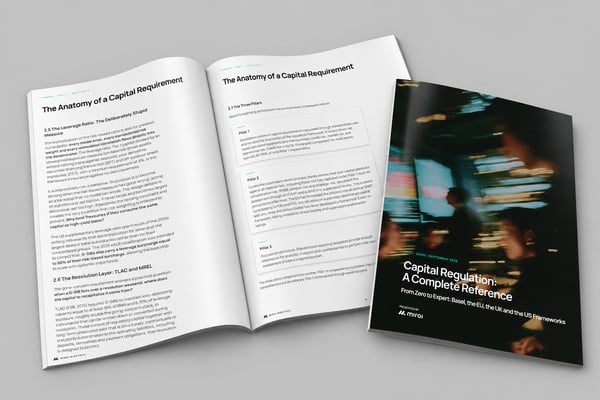
Key Areas Covered
Table of Content
-
The foundations of bank capital, including why banks hold capital and how regulators measure it
-
The global Basel framework, covering capital definitions, credit and market risk, operational risk, buffers, leverage and TLAC
-
The EU framework under CRR3 and CRD VI, including the SREP process, P2R and P2G, and MREL
-
The UK framework after Brexit, including Basel 3.1, Pillar 2A, the PRA buffer and the Strong & Simple regime
-
The US framework, including the current capital rule, the Basel III Endgame saga and stress testing through CCAR and DFAST
-
A comparative synthesis across all three jurisdictions, including case studies from the 2023 banking turmoil and an outlook on what is likely to shape the next phase of capital regulation
Who Should Read This?
Capital planning managers and regulatory capital leads navigating Basel 3.1, CRR3 or US Endgame implementation
Treasury and ALM professionals with capital responsibilities alongside liquidity and IRRBB
CFOs, CROs and heads of regulatory affairs setting capital strategy across multiple jurisdictions
Risk technology decision-makers evaluating platforms for integrated balance sheet management
Consultants and advisors supporting banks through prudential framework transformation