
 Book a Demo


A five-year TCO analysis of fragmented versus integrated ALM, FTP, and Regulatory Reporting
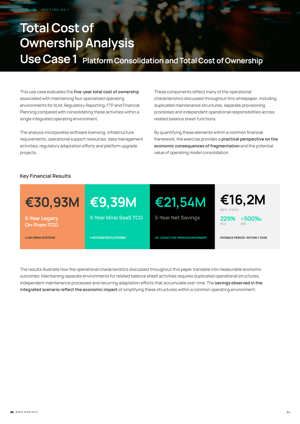
€21.54M in 5-Year TCO Savings | €16.22M NPV | 229% ROI | Payback Within Year 1
Banks running Regulatory Reporting, ALM, FTP, and Financial Planning on separate platforms are paying more than they realize. This whitepaper quantifies that cost and shows what consolidating onto a single integrated balance sheet management software environment delivers in practice.
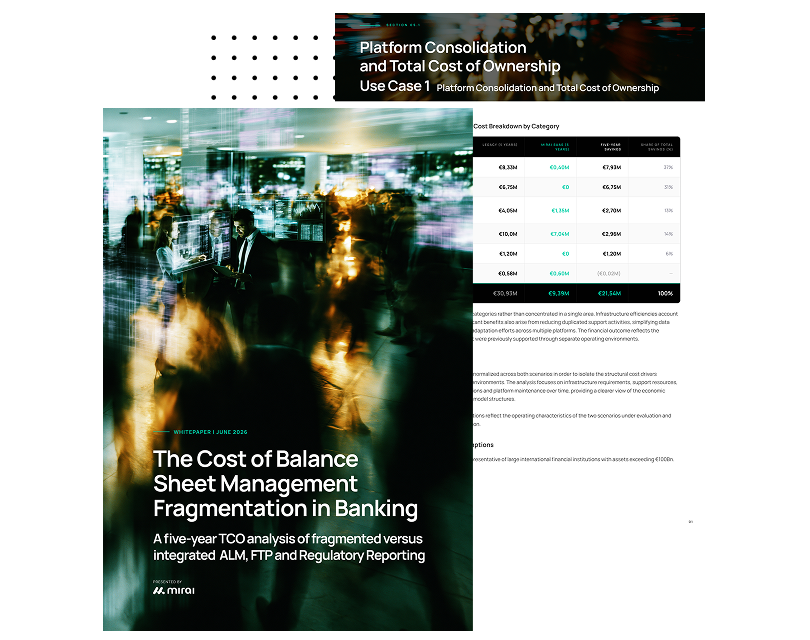
Fragmented technology stacks are the default in banking, not the exception. Over time, institutions assemble specialized platforms to support each function, with each one introducing its own operational processes, vendor obligations, and maintenance cycles. Because costs are distributed across teams and budgets, the cumulative impact stays invisible.
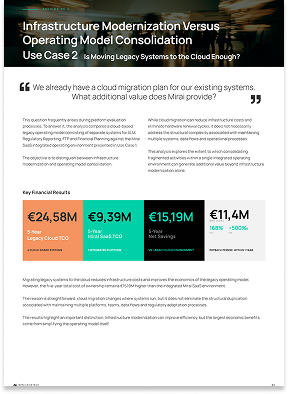
This whitepaper evaluates two representative transformation scenarios: consolidation of four specialized on-premises systems, and consolidation of four cloud-based legacy systems into a single integrated operating environment. For each, it models five-year total cost of ownership, discounted cash flows, NPV, ROI, and payback period.
The results are consistent across both scenarios. For the representative institution evaluated, moving to an integrated balance sheet management software model reduced five-year TCO by up to €21.54M, generated an NPV of €16.22M, and achieved payback within the first year. Compared to a cloud-based legacy environment, the integrated model delivered €15.19M in savings over five years.
The finding that matters for bank technology cost reduction planning: modernizing individual platforms does not reduce the cost of running multiple ones.
What You'll Find Inside
The whitepaper combines operating model analysis with detailed financial modeling. It covers how fragmented technology landscapes emerge, the operational challenges they create, and the implications for data governance, regulatory responsiveness, and balance sheet management at scale.
The analysis quantifies five-year TCO, annual savings, NPV, ROI, and payback across both transformation scenarios. It also surfaces value sources typically excluded from technology business cases: data consistency, vendor dependency, and operational resilience.
See the full analysis. Download the whitepaper.


Key Areas Covered
What Integrated Operating Models Make It Possible that Fragmented Environments Cannot
-
The operational impact of fragmentation across Finance, Risk, and Treasury functions
-
Operating model complexity and its economic consequences
-
Technology consolidation and integrated operating models
-
A five-year TCO analysis of fragmented on-premises and integrated SaaS operating models
-
A five-year TCO analysis of fragmented cloud-based and integrated SaaS operating models
-
NPV, ROI, IRR, and payback evaluation
-
Cloud migration versus operating model consolidation
-
Sources of value beyond direct technology costs
Who Should Read This Whitepaper?
This publication is intended for:
Chief Financial Officers (CFOs)
Chief Risk Officers (CROs)
Treasurers and ALM Leaders
Heads of Regulatory Reporting
Finance Transformation Leaders
Enterprise Architecture and Technology Leaders
Strategy and Operating Model Transformation Teams
Anyone curious about the economics of complexity in banking
It will be particularly relevant for institutions evaluating platform consolidation initiatives, operating model transformation programs, or the long-term economics of fragmented balance sheet management environments.