
 Book a Demo


A detailed reference on LCR, NSFR, ILAAP and supervisory reporting for treasury, ALM and risk professionals working across more than one jurisdiction.
What Is Liquidity Risk Regulation, and Why Does It Matter Now?
Liquidity risk regulation exists because a bank can be solvent and still fail if it cannot meet its payment obligations when they fall due. Since the 2007/08 crisis, supervisors have built a framework around two core ratios, the Liquidity Coverage Ratio and the Net Stable Funding Ratio, supported by internal governance, stress testing and standardized reporting.

The Basel Committee sets the global baseline, but the European Union, the United Kingdom and the United States have each implemented it differently. Covered bonds qualify as top-tier liquid assets in the EU but not in the US. The UK layers its own adequacy standard on top of the LCR. The US collects raw position-level data instead of completed templates.
The 2023 failures of Silicon Valley Bank and Credit Suisse tested this framework for the first time at scale, and each jurisdiction has continued to develop its own response since.
This guide walks through Basel, the EU, the UK and the US individually, covering the legal framework, calibration, reporting and current developments for each.
What Are the Key Findings?
-
Deposit runs are outpacing regulatory assumptions. Silicon Valley Bank lost around 25% of its deposits in a single day, against LCR run-off assumptions of 10 to 40% over 30 days.
-
HQLA eligibility diverges sharply by jurisdiction. The EU treats qualifying covered bonds as Level 1 assets with a 7% haircut, while the US excludes covered bonds from HQLA entirely.
-
The US applies liquidity requirements to a small tier of institutions only, with a hard cliff at $100 billion in assets, the exact threshold that left Silicon Valley Bank outside full LCR and NSFR scope.
-
Reporting philosophy differs fundamentally. The EU and UK collect completed calculation templates, while the US collects raw position data and calculates the ratios itself through FR 2052a.
-
Both the UK (CP5/26) and the US (the 2026 Treasury liquidity reset) are now proposing to let central bank borrowing capacity count toward liquidity adequacy, a departure from the original Basel principle that buffers should be entirely bank-owned.
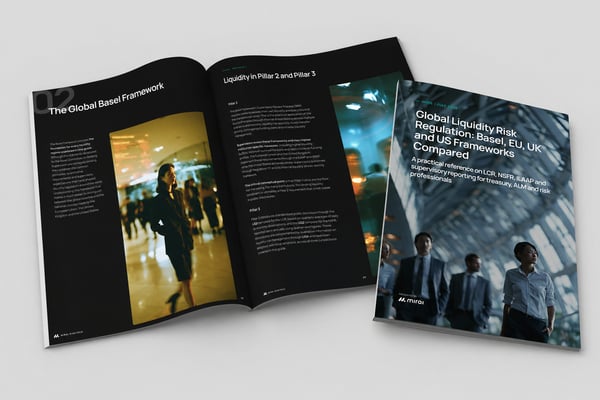
See how your framework compares across all four regimes. Download the complete guide 'Liquidity Regulation: From Zero to Expert - Basel, the EU, the UK and the US Frameworks.'

Key Areas Covered
Table of Content
-
Liquidity risk and why it is regulated
-
The Global Basel Framework
-
The European Union Regulation
-
The United Kingdom Regulation
-
The United States Regulation
-
Cross jurisdiction comparison and reference, including a regulatory timeline, glossary, and source document register
Who Should Read This?
ALM managers, treasury professionals and liquidity risk officers responsible for LCR, NSFR and ILAAP compliance across more than one jurisdiction
Regulatory reporting leads reconciling COREP, PRA110 and FR 2052a requirements
CROs, CFOs and heads of regulatory affairs evaluating supervisory exposure and platform investment
Risk technology and transformation leads assessing how fragmented reporting infrastructure affects supervisory credibility
Consultants and advisors supporting clients across multiple regulatory regimes