
 Book a Demo


A practitioner guide to integrated scenario simulation, stress testing and behavioral modeling for treasury, ALM and risk teams preparing for their next SREP cycle.
The resilience of a financial institution is rarely determined by a single metric or regulatory ratio. It emerges from the interaction between funding structures, liquidity conditions, stress assumptions, management decisions and the institution’s ability to respond coherently as market environments change over time. In this environment, ILAAP and ICAAP frameworks have evolved into broader prudential management processes connected to liquidity planning, stress testing, balance-sheet forecasting and forward-looking decision-making.
Institutions are expected to demonstrate more than regulatory compliance alone, and supervisory attention is now more focused on how vulnerabilities emerge under stress, how liquidity and funding conditions evolve across changing market environments, and how management actions would realistically operate under deteriorating conditions. Prudential credibility ultimately depends on the institution’s ability to maintain coherent methodologies, connected assumptions and operational consistency across interconnected exercises, together with a credible understanding of the risks embedded within the balance sheet.
What You'll Explore in this Doc
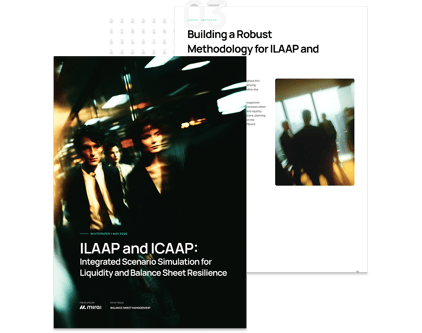
This whitepaper explores how integrated scenario simulation supports these objectives through analytical environments capable of aligning stress testing, behavioral assumptions, balance-sheet projections, and prudential planning within a common operational framework.
While the operational examples developed throughout the publication focus primarily on ILAAP, many of the broader methodological principles also extend across interconnected prudential processes linked to capital planning, recovery analysis and supervisory reporting.
The discussion covers:
-
stress scenarios,
-
forecasting methodologies,
-
funding vulnerabilities,
-
contingency actions,
-
governance expectations
-
and the operational importance of integrated simulation capabilities across modern prudential frameworks.
It also examines the growing pressure institutions face to reduce fragmentation across treasury, planning, regulatory reporting and risk functions as supervisory exercises become more granular, interconnected and simulation-intensive.
Why It Matters
This matters because balance-sheet resilience depends heavily on the institution’s ability to connect forecasting, stress testing, funding analysis and management actions within a coherent operational framework. Market volatility and evolving supervisory expectations are reinforcing the role of integrated analytical environments in helping institutions understand vulnerabilities, assess resilience and support forward-looking prudential decision-making over time.
Explore how institutions are connecting stress testing, behavioral modeling and balance sheet management within a single supervisory-ready framework. Download the whitepaper to understand what that transition looks like in practice.


What You’ll Find Inside
Key Areas Covered
-
The role of ILAAP and ICAAP within the broader prudential framework
-
ILAAP methodologies and prudential frameworks
-
Balance-sheet forecasting and liquidity stress scenarios
-
Idiosyncratic, systemic, combined and reverse stress testing
-
Funding vulnerabilities and behavioral assumptions
-
Management actions and contingency planning
-
Integrated simulation and governance capabilities
-
Prudential reporting and operational consistency
Table of Content
-
A practical overview of evolving ILAAP and prudential management expectations
-
Explanations of balance-sheet forecasting and liquidity stress-testing methodologies
-
Discussions around behavioral modeling, funding resilience, and management actions
-
Examples of integrated simulation capabilities and connected analytical environments
-
Insights into operational challenges created by fragmented infrastructures and disconnected assumptions
-
A forward-looking perspective on prudential management and balance-sheet resilience