November 19, 2026 - 3pm UTC
About this Webinar Series
Mirai hosts a bi-monthly series of webinars, exclusive live walkthroughs where attendees experience an in-depth tour of the Mirai platform. Not just hearing how Mirai works, but seeing in practice with real cases, and learning how to take the most out of it. Each session is dedicated to a specific area of the platform, building a complete picture of how modern banks connect strategy with execution in one integrated, cloud-native environment.
With its modular architecture, Mirai is designed to bring clarity, agility, and governance across treasury, risk, and finance functions, unifying data, analytics, modeling, and reporting in a single source of truth for smarter decision-making.
Each webinar is a structured 1h live walkthrough in English, divided into practical modules, delivered in a dynamic and engaging format.
Important: This session will not be recorded. All insights and live Q&A are only available to attendees. Don’t miss this chance to interact in real time and get answers to your specific questions.
About this Session
This edition explores deposit beta modeling and its impact on bank profitability and interest rate risk, with a focus on how deposit behavior and pricing assumptions influence outcomes across different rate scenarios.
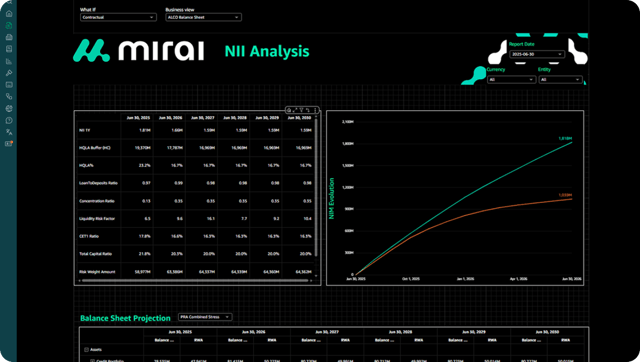
Attendees will see how Mirai supports the configuration and analysis of static and dynamic beta models, the review of scenario results and reports across key metrics such as NII, deposit costs, repricing and EVE, and the use of Mirai AI to explore the trade-off between deposit pricing and customer attrition.
Agenda
A practical, live session covering:
-
Market Context and Key Concepts
An overview of the current interest rate environment, rate-cycle developments and the EBA IRRBB heatmap, including NII outliers and the key concepts behind the demonstration.
-
Reviewing Reports and Beta Scenario Results
Review reports and results from beta scenarios, side by side review of different rate paths and pricing decisions.
-
Scenario Setting & Configuration: Rate Cycles and Alternative Beta Models
See how to configure rate scenarios and alternative deposit beta models, including:
-
Interest rate paths
-
Static beta models
-
Dynamic beta models
-
Additional beta model specifications
-
Lag effects
-
Mirai AI Modeling: Optimizing Pricing and Attrition
Discover how Mirai AI can support deposit beta optimization by exploring the trade-off between deposit pricing and customer attrition.
-
Live Q&A
Open discussion with the Mirai team: bring your questions, edge cases, and specific use cases you’d like to discuss.
Save the Date
19 November at 3pm UTC | 4pm CET*.
*Please double-check your local time to ensure you join at the correct time.
Save Your Spot
Seats are limited to keep the session interactive. Book your spot here.

 Book a Demo