
 Book a Demo


Backed by recognition, proven in practice.

2025 Chartis Category Leader in 7 RiskTech Quadrants

Trusted by Banks in 20+ Countries Worldwide

Implementation in Weeks
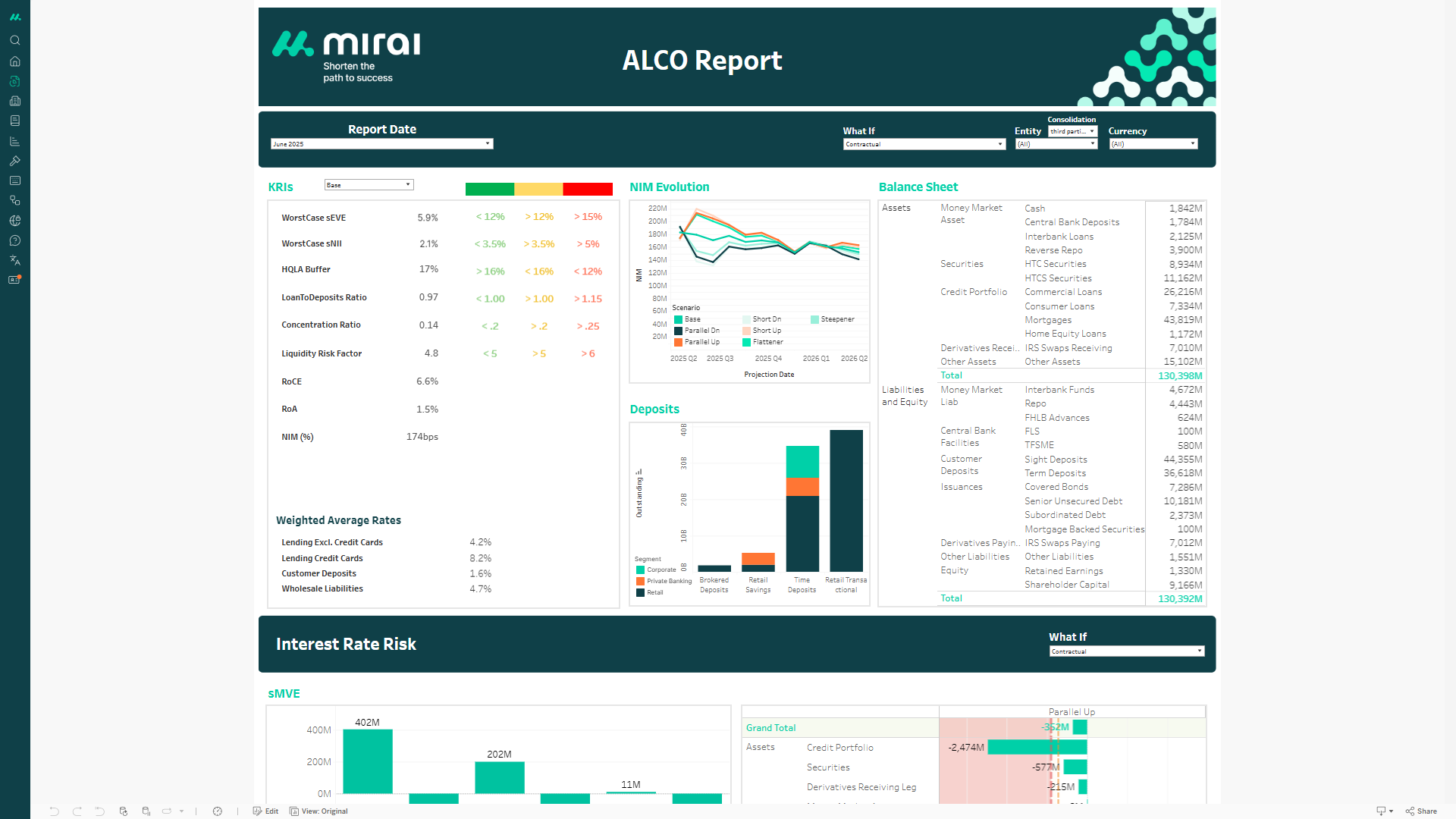
What Mirai Brings to Mid-Size Banks
Three connected modules, ALM & Liquidity, FTP and Profitability, and Regulatory Reporting, running on a single platform, giving Risk, Finance and Treasury one reconciled data source instead of separate figures to align before every decision.

Mirai ALM & Liquidity
Runs IRRBB and liquidity simulations in parallel, on the same data Risk and Finance both work from, giving ALCO one reconciled view of risk and profitability instead of two separate versions to align beforehand. Configuration adapts to different business units and charts of accounts without losing governance, keeping every result traceable back to source.

Mirai Regulatory Reporting
Applies regulatory rules automatically as data loads, generating outputs in supervisor-ready format across the frameworks, risk types and liquidity ratios each institution reports on. Full data history is kept for every submission, so variance analysis, trend tracking and audit queries get answered instantly instead of pulled together by hand.

Mirai FTP & Profitability
Calculates commercial margin at contract level, decomposing each rate into base funding cost, liquidity spread, credit spread and regulatory cost, so pricing decisions rest on true margin instead of an average across the book. The same view replaces separate, inconsistent FTP outputs from different teams with a single figure Treasury and Finance both work from.
What Your Existing Solution Can't Do

Zero Hidden Costs
- No extra charges for updates, new templates or regulatory changes.
- Transparent, predictable pricing from day one.


Zero-Downtime Upgrades
- Cloud-native architecture: updates roll out automatically, with zero downtime and no infrastructure to maintain.
- No added cost and no separate implementation project.

Real-Time Regulatory Updates
- New rules and templates are incorporated as they're published.
- No waiting on vendor release cycles to stay compliant.

Contract-Level Traceability
- Every figure across ALM, Liquidity, FTP and Regulatory Reporting traces back to its source contract.
- No black box. Full lineage available at any point for regulators, auditors or model validation.