
 Book a Demo


A practical guide for ALM, treasury, and risk leaders navigating continuous compliance, explainable AI, scenario modeling, and digital resilience in 2026.
Why Are Traditional BSM Tools No Longer Enough in 2026?
When volatility is permanent, supervisors ask harder questions, and balance sheet decisions must be explained, not just calculated. Traditional ALM and BSM tools stop being enough.
In 2026, Balance Sheet Management is no longer about explaining the past.
Finance and risk teams need continuous visibility, forward-looking scenarios, and explanations they can stand behind, especially when decisions are made under pressure.
Why This Matters in 2026:
-
Volatility is structural
-
Regulatory expectations are rising
-
Digital and third-party dependencies are unavoidable
-
Static dashboards and retrospective reporting no longer keep up.
 Leading institutions are moving toward always-on, scenario-driven, and explainable intelligence.
This report shows how that shift is already taking shape in practice. And it is written for people who prepare ALCO meetings, run stress tests, explain LCR movements, and answer follow-up questions from regulators—often with little time and zero margin for error.
It focuses on what actually changes in day-to-day work, not abstract trends.
What You’ll Be Able to Do After Reading This Report
-
Understand how organizations are using scenario-based modeling to better assess potential balance sheet impacts, rather than relying solely on reactive analysis
-
Gain clarity on how month-over-month movements in key metrics (LCR, NII, liquidity buffers) can be explained more consistently, without relying on fragmented or stitched-together reports
-
Be better prepared for supervisory conversations by understanding how continuous, traceable risk and compliance evidence supports confidence and defensibility
-
Understand how AI can support professional judgment by explaining drivers and assumptions rather than producing black-box outputs
-
Recognize third-party and ICT dependencies that can disrupt liquidity, operations, or regulatory standing if left unmanaged
-
Understand the importance of working from a shared and consistent view of the balance sheet across Finance, Risk, and Compliance functions
No generic “efficiency gains.” Just fewer surprises and better answers when it matters.
If you want to prepare balance sheet decisions with more confidence—and spend less time explaining surprises after the fact—this report is a good place to start.
It will help you understand what is changing in Balance Sheet Management and why many current tools and processes will struggle in 2026.
Download the 2026 Global RiskTech Balance Sheet Management Trends Report

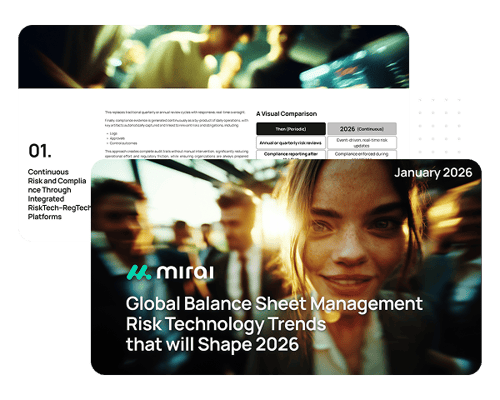
What the Report Covers
Content Table
- Introduction:
Why periodic reviews and static dashboards are no longer sufficient in 2026. - Trend 1: Continuous Risk and Compliance Through Integrated RiskTech and RegTech Platforms.
- Trend 2: The Next Phase of AI in Finance—Explainable, Decision-Ready Intelligence.
- Trend 3: Scenario-Based Risk Modeling for Persistent Volatility.
- Trend 4: Third-Party, ICT Risk, and Digital Resilience as Core BSM Capabilities.
- Turning Insight into Action: Balance Sheet Management in 2026 and beyond
Key Findings on RiskTech Trends in 2026
- Continuous risk and compliance is replacing periodic review.
- Integrated RiskTech–RegTech platforms are becoming the control layer for financial resilience
- Explainable, decision-ready AI looks like in daily BSM and ALM work
- Scenario modeling has become a core capability, not an advanced feature
- Third-party and ICT risk have moved to the balance sheet core.
Who Should Read This?
This report is designed for decision-makers and practitioners across finance, risk, and technology, including:
Heads of Asset and Liability Management
ALM, Treasury, and Finance professionals
Regulatory reporting and compliance teams
Data, architecture, and transformation leaders
Anyone shaping a unified risk–regulatory ecosystem.