Book a Demo





Cloud migration has transformed the technology landscape of financial institutions over the past decade. Infrastructure has become more scalable, hardware investment cycles have been reduced, and many organizations now benefit from greater flexibility in the way computing resources are deployed. For many institutions, migrating balance sheet management applications to the cloud has become an important milestone within broader technology modernization programs.
As these modernization initiatives mature, a different question begins to emerge. If infrastructure has already been modernized, where does the next layer of value come from?
Audio Article
This article examines a representative five-year use case comparing four independent cloud-hosted balance sheet management platforms with a single integrated SaaS operating environment. Rather than evaluating cloud migration itself, it explores where additional economic value can still be created once infrastructure modernization has already taken place, and why simplifying the operating model remains an important source of long-term efficiency.
Cloud migration removes many of the costs associated with physical infrastructure, but it does not necessarily change the way balance sheet management operates. Asset & Liability Management (ALM), Funds Transfer Pricing (FTP), Regulatory Reporting and Financial Planning may continue to rely on separate applications, independent data pipelines and distinct operational processes. As long as these functions remain fragmented, institutions continue to incur the recurring cost of coordinating them.
Cloud Migration Solves One Dimension of Modernization
Modern cloud architectures have transformed the way balance sheet management platforms are deployed and maintained. Hardware investment cycles are reduced, capacity becomes more flexible, and infrastructure ownership gives way to service-based operating models. These advantages have made cloud adoption one of the defining elements of technology modernization across the banking industry.
Many financial institutions continue to operate the same collection of independent applications they managed before the migration. Each platform retains its own data repositories, interfaces, methodologies, and release cycles, while information continues to move across separate environments supporting ALM, FTP, Regulatory Reporting, and Financial Planning. The infrastructure has evolved, yet much of the operational effort required to keep these functions aligned remains unchanged.
Understanding this distinction is essential when evaluating long-term Total Cost of Ownership. Infrastructure is only one component of the operating model. Support resources, data management, software licensing, regulatory adaptation, and platform evolution continue to shape the economics of balance sheet management, regardless of where the applications are hosted.
Building the Business Case
Many financial institutions have already completed a significant part of their modernization journey. Legacy infrastructure has been replaced by cloud-hosted applications, technology operations have become more flexible, and dependence on traditional data centers has been substantially reduced. From an infrastructure perspective, the transformation is well underway.
What often remains unchanged is the operating model built around those applications. Asset & Liability Management (ALM), Funds Transfer Pricing (FTP), Regulatory Reporting and Financial Planning continue to operate on separate cloud-hosted platforms, each with its own operating model and operational responsibilities.
This typically involves:
-
Dedicated support teams
-
Independent data management processes
-
Separate vendor relationships
-
Distinct release and upgrade cycles
The infrastructure may have evolved, while the operational landscape continues to reflect years of incremental development.
To understand the financial implications of this scenario, the analysis compares this representative cloud-based environment with a single integrated SaaS platform supporting the same functional scope over a five-year period. More than measuring the value of cloud migration itself, the analysis seeks to isolate the economic impact of simplifying the operating model once infrastructure modernization has already been achieved.
The comparison evaluates the principal cost categories that continue to shape Total Cost of Ownership:
-
Software licensing
-
IT support resources
-
Data management and feed support
-
Regulatory adaptation
-
Major platform upgrades and implementation
Because both scenarios already operate in cloud-based environments, infrastructure is no longer the defining variable. The analysis instead focuses on the recurring operational costs associated with supporting, connecting, and evolving multiple independent platforms.
The Business Case in Numbers
Once infrastructure modernization is treated as a common starting point, the financial case for operating model integration remains remarkably strong.
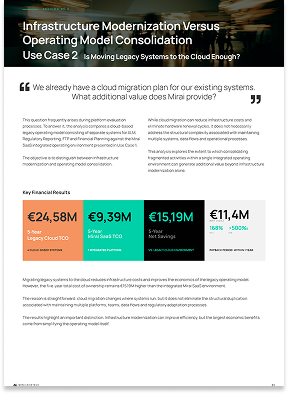
The representative cloud-based environment generates a five-year TCO of €24.58 million, compared with €9.39 million for the integrated SaaS operating environment.
The resulting business case delivers:
-
€15.19 million in net savings over five years
-
11.41 million in Net Present Value (10% discount rate)
-
Payback within the first year
These results demonstrate that substantial economic value remains available even after institutions have completed their migration to cloud infrastructure. The difference lies in the way balance sheet management is organized rather than where the applications are hosted.
The Real Value Is in the Operating Model, Not the Infrastructure
Where Does the €15.19 Million Come From?
Once infrastructure has been modernized, the business case begins to look very different. Greater opportunities for efficiency emerge within the operating model itself, where independent applications continue to generate recurring costs through duplicated operational structures and the ongoing effort required to keep multiple platforms aligned.
The representative five-year analysis identifies five principal sources of value:
-
IT support resources
-
Data management and feed support
-
Software licensing
-
Regulatory adaptation
-
Platform evolution and implementation
Taken together, these categories reveal where the remaining value of modernization is created. As the operating model becomes more integrated, recurring operational complexity gives way to a simpler environment where data, methodologies and change can move more naturally across Finance, Risk and Treasury. The business case shifts from modernizing technology to improving how technology supports the balance sheet.
The Real Value Lies Beyond Infrastructure
One of the most interesting conclusions emerging from the analysis is how the sources of value evolve once infrastructure modernization has been completed. While cloud migration changes the technology landscape, the operating model continues to shape how balance sheet management functions work together and how much effort is required to support them over time.
Many of the recurring costs associated with balance sheet management are not created by the infrastructure itself. They arise from maintaining separate operational structures, supporting independent applications, managing multiple data environments, and implementing change across platforms that ultimately support the same balance sheet.
As the operating model becomes more integrated, these activities can be simplified. Support resources are consolidated, data management becomes more consistent, and regulatory changes can be implemented through a common analytical framework. The result is an environment where specialist teams spend less time maintaining the connections between systems and more time interpreting the information those systems produce.
Operating Model Complexity Does Not Disappear in the Cloud
Moving balance sheet management applications to the cloud changes where they run, but it does not necessarily change how they work together. A cloud-hosted environment can still consist of independent platforms supporting Asset & Liability Management (ALM), Funds Transfer Pricing (FTP), Regulatory Reporting and Financial Planning, each with its own operating model.
That normally includes:
-
Separate vendor relationships
-
Independent release cycles
-
Dedicated operational support
-
Distinct methodologies and data processes
The connections between these platforms remain part of the operating model. Information continues to move across interfaces, data still needs to be validated and reconciled, and changes often have to be implemented across several environments before they are reflected consistently throughout the institution.
Cloud infrastructure simplifies the technology landscape, while operating model integration simplifies the way balance sheet management functions work together. The two approaches address different dimensions of modernization, which explains why significant opportunities for efficiency remain even after the migration to the cloud has been completed.
Why Integration Continues to Create Value
Some of the financial benefits of integration become visible as soon as redundant platforms are removed. Others emerge more gradually, becoming part of the institution's day-to-day operation. As regulatory requirements evolve, methodologies are refined, and business priorities change, a shared operating environment requires fewer adaptations, fewer coordinated releases, and less effort to preserve consistency across connected functions.
This cumulative effect explains why the value of integration extends well beyond the initial implementation. Over time, the operating model becomes easier to maintain and govern, while also providing a stronger foundation for future change. Finance, Risk and Treasury teams can devote more attention to understanding the balance sheet rather than maintaining the systems that support it.
The Financial Value of Integration
This representative business case illustrates how technology modernization extends beyond infrastructure. Once cloud migration has been completed, another layer of value remains to be unlocked through the simplification of the operating model itself.
Bringing Asset & Liability Management (ALM), Funds Transfer Pricing (FTP), Regulatory Reporting and Financial Planning together within a single operating environment reduces the recurring effort required to support, connect and evolve these closely related disciplines. The result is a simpler foundation for managing the balance sheet, one that allows information to move more naturally across Finance, Risk and Treasury while reducing the operational complexity that accumulates around independent platforms.
This is the approach behind the Mirai platform, which brings these interconnected functions together within a single SaaS operating environment. By simplifying the operating model rather than focusing solely on the underlying infrastructure, Mirai enables financial institutions to build on the benefits of cloud migration while creating a more integrated foundation for balance sheet management.
Explore the full cost of Balance Sheet fragmentation
This is the second use case in 'The Cost of Balance Sheet Management Fragmentation,' Download the whitepaper for the complete five-year analysis across both scenarios.
The Real Value Is in the Operating Model, Not the Infrastructure
FAQs: Cloud Migration vs. Operating Model Integration
-
What is operating model integration in balance sheet management?
It means bringing ALM, FTP, Regulatory Reporting, and Financial Planning into a single operating environment, rather than running them as separate applications with independent support, data, and release cycles. -
Does cloud migration alone reduce balance sheet management costs?
Cloud migration lowers infrastructure and hardware costs, but institutions often continue running the same fragmented set of applications, so most of the coordination and support costs remain. -
How much can financial institutions save by integrating their operating model?
The representative five-year analysis shows €15.19 million in net savings and €11.41 million in NPV when moving from four independent cloud-hosted platforms to one integrated SaaS environment. -
What cost categories does operating model integration affect in Balance Sheet Management?
Software licensing, IT support resources, data management and feed support, regulatory adaptation, and platform evolution and implementation. -
Is operating model integration relevant if we've already migrated to the cloud?
Yes. The comparison in this analysis assumes both scenarios are already cloud-hosted — the savings come specifically from consolidating the operating model, not from the cloud migration itself.