Book a Demo





In December 2025, the Bank for International Settlements (BIS), through its Regulatory Consistency Assessment Program (RCAP), published its assessment of the PRA implementation of the NSFR. This marked the completion of NSFR assessments across the five largest jurisdictions: China, Japan, the United States, the European Union, and the United Kingdom.
This matters because the NSFR is designed to limit excessive reliance on short-term funding and strengthen the resilience of the banking system to funding shocks.
Audio Article
We took this opportunity to collate all the assessments to see what they might tell us, and to reflect on the NSFR as a whole.
Across jurisdictions, we observe that the PRA, ECB, and to an extent the Federal Reserve have introduced similar and, in our view, well-considered adjustments to the original BIS framework. In practice, however, only PRA-regulated banks appear to experience material impacts on the ratio as a result of these changes.
When looking at the metric overall, the NSFR is not a binding constraint in the manner that the LCR is. However, we explore some empirical investigations performed on European banks that provide evidence that the NSFR has had a positive impact in reducing maturity transformation risk and may also have helped increase profitability. Further analysis is required and is outside the scope of this article.
Regulatory Consistency Assessment Programme NSFR Assessment
In 2012, the BIS established the Regulatory Consistency Assessment Programme (RCAP) as a means of monitoring the implementation of its standards across jurisdictions.
Assessments grade jurisdictions on their implementation across scope, disclosures, and the application of technical requirements.
RCAP sets four components for NSFR assessment:
-
Scope, minimum requirements, and application issues
-
Available stable funding (ASF)
-
Required stable funding (RSF)
-
NSFR disclosure requirements
A reminder on NSFR
The Net Stable Funding Ratio is a metric designed as a measure of structural funding risk. Its purpose is to limit excessive maturity transformation. It is formulated as the ratio of “Available Stable Funding” to “Required Stable Funding.”
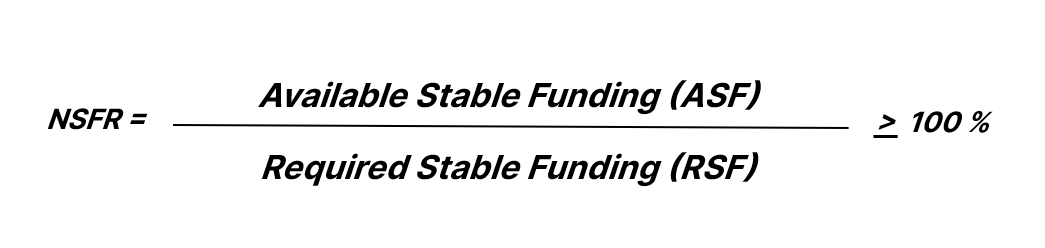 Available Stable Funding (ASF) represents sources of funding, i.e., capital and liabilities. Required Stable Funding (RSF) represents uses of funding, i.e., assets and net off-balance-sheet exposures.
Factors between 0% and 100% are applied to balances based on liquidity classifications. For example, total regulatory capital is classified as having a 100% ASF factor, meaning the full balance can be counted as a source of funding. Unencumbered Level 2A assets have an RSF factor of 15%, meaning this portfolio should have a funding balance from available funding equal to 15% of its value.
Assessment Results for the Five Largest Jurisdictions
RCAP visits each jurisdiction’s regulator and analyzes its interpretation of the regulation, as well as the disclosures of each member bank within the jurisdiction.
The results of the RCAPs across the 5 largest jurisdictions are in the following table:
|
|
UK |
US |
Japan |
EU |
China |
|
Date RCAP published |
Dec-25 |
Jul-23 |
Sept-22 |
Jul-22 |
Nov-19 |
|
Overall Result |
Largely Compliant |
Largely Compliant |
Compliant |
Largely Compliant |
Compliant |
|
Scope, minimum requirements and application issues |
Compliant |
Compliant |
Compliant |
Compliant |
Compliant |
|
Available stable funding (ASF); |
Compliant |
Largely Compliant |
Compliant |
Compliant |
Compliant |
|
Required stable funding (RSF) |
Partially non-compliant |
Materially non-compliant |
Largely compliant |
Largely compliant |
Compliant |
|
Disclosure requirements |
Compliant |
Compliant |
Compliant |
Compliant |
Compliant |
RCAP assessment grades for the five largest BIS jurisdictions
Notes on the table:
Assessment scale: Compliant, Largely Compliant, Partially non-compliant / Materially non-compliant*, Non-compliant
*The UK assessment uses the term “partially non-compliant” as the third grade, while other jurisdictions use “materially non-compliant.” For the purposes of this analysis, we assume this difference is purely a matter of terminology and that both classifications are equivalent.
Japan and China are graded as fully compliant, while the UK, US, and EU are graded as largely compliant.
RCAP also provides a point-by-point assessment of where a jurisdiction diverges in its interpretation, classifying each difference as material or not material. In the case of ASF and RSF, it also calculates the impact on the ratio based on the different applications.
The main area of deviation from the BIS standard across jurisdictions comes from the loosening of RSF factor requirements. The UK has 14 divergences related to RSF, 5 of which are material. Indeed, there is only one other material divergence across all other jurisdictions.
|
TOTAL DIVERGENCES |
UK |
US |
Japan |
EU |
China |
|
Date of RCAP published |
Sep-25 |
Jul-23 |
Sep-22 |
Jul-22 |
Nov-19 |
|
Scope, minimum requirements, and application issues |
0 |
1 |
0 |
0 |
0 |
|
Available stable funding (ASF); |
2 |
2 |
0 |
1 |
0 |
|
Required stable funding (RSF) |
14 |
3 |
3 |
9 |
0 |
|
Disclosure requirements |
2 |
0 |
0 |
0 |
0 |
|
TOTAL |
18 |
6 |
3 |
10 |
0 |
|
MATERIAL DIVERGENCES |
UK |
US |
Japan |
EU |
China |
|
Date of RCAP published |
Sep-25 |
Jul-23 |
Sept-22 |
Jul-22 |
Nov-19 |
|
scope, minimum requirements and application issues |
0 |
0 |
0 |
0 |
0 |
|
available stable funding (ASF); |
0 |
0 |
0 |
0 |
0 |
|
required stable funding (RSF) |
5 |
1 |
0 |
0 |
0 |
|
disclosure requirements |
0 |
0 |
0 |
0 |
0 |
PRA and EBA Deviations from BIS
The EU and UK share a large number of interpretations that deviate from the BIS framework. This is unsurprising, as the EBA NSFR drafting predates Brexit. Post-Brexit, the UK introduced a small number of additional adjustments.
Differences in materiality between the EU and PRA are largely due to differing balance sheet compositions. It should also be noted that there is more than a year between the assessments of jurisdictions, and differing market conditions likely contribute to these variations.
The common deviations are summarized below and reflect a consistent theme of loosening RSF requirements.
|
Measure |
Deviation description |
From |
To |
Effect vs BIS |
|
RSF |
Collateralised L1 securities financing transactions (mostly Repos) |
10% |
0 |
Loosening |
|
RSF |
Collateralised securities financing transactions lower than L1, (mostly Repos) |
15% |
5% |
Loosening |
|
RSF |
L1 Unencumbered Extremely high-quality covered bonds |
15% |
7% |
Loosening |
|
RSF |
Allow L1 HQLA received as variation margin offset derivative assets |
Cash only |
Cash and L1 HQLA |
Loosening |
|
RSF |
Allow all unencumbered L1 HQLA 0% RSF |
5% |
0 |
Loosening |
|
RSF |
Encumbered covered bonds in a cover pool |
100% |
85% |
Loosening |
|
RSF |
Haircuts on unencumbered shares/Collective investment undertakings to be aligned with LCR. |
50% |
various <50% |
Loosening |
|
ASF |
Expand the definition of FI to include CU, brokerage, and credit unions, personal investment companies, and |
Not permitted |
Permitted |
Loosening |
These commonalities reveal a set of overlapping priorities related to aligning the NSFR with the LCR, recognizing the importance of Repos as a liquidity instrument, and reducing transactional overhead associated with collateral.
In more detail:
-
Removing the RSF charge for Repos [EG1] aligns with the LCR and emphasizes the importance placed by the ECB and PRA on this market as a key source of liquidity.
-
Removing RSF requirements for unencumbered Level 1 HQLA avoids conflicts with LCR liquidity objectives and prevents disincentives for holding liquidity buffers.
-
Allowing Level 1 HQLA to be used as variation margin reduces the need for conversion to cash, lowering transaction costs and operational complexity. It also avoids potential unintended consequences in UK and EU markets where cleared derivatives are widely used.
The Federal Reserve has also made similar adjustments regarding variation margin and the treatment of unencumbered Level 1 HQLA.
Our view is that these are sensible and proportionate deviations from the original BIS framework.
For banks operating across PRA and ECB jurisdictions, these divergences in RSF treatment translate into material differences in how NSFR is calculated and reported. Mirai Regulatory Reporting handles jurisdiction-specific NSFR parameterization natively, ensuring that PRA-regulated and EBA-regulated entities within the same group apply the correct factor sets without manual reconciliation.
NSFR Overall Results and Impact
In their assessments, RCAP aggregates disclosures from each jurisdiction’s member banks and calculates an overall regional NSFR.
These are in the table below, and the results show that NSFR levels are significantly above the regulatory threshold across jurisdictions.
|
|
UK |
US |
Japan |
EU |
China |
|
NSFR |
141.80% |
121% |
125.40% |
124% |
120% |
During the consultation process, a widely expressed criticism of the NSFR was that it would act as a weak constraint. The argument was that capital constraints would dominate, with funding structure becoming an outcome of capital allocation. Under this view, the regulatory burden and potential unintended constraint on the more binding LCR may not be justified.
The RCAP results appear to align with this perspective.
However, maturity transformation failure remains one of the most well-known causes of banking crises. It therefore seems premature to dismiss the metric solely based on these observations.
Empirical research provides additional perspective.
Casu et al. (2026) examined the impact of liquidity regulation on Eurozone banks’ lending between 2008 and 2021. Their findings suggest that, in preparation for NSFR implementation, banks adjusted their balance sheet composition in anticipation of the introduction of the ratio. Higher NSFR levels were associated with increased short-term lending and reduced long-term lending, indicating a reduction in maturity transformation risk.
For institutions looking to track their own NSFR trajectory at this level of granularity, Mirai ALM & Liquidity provides contract-level NSFR monitoring with the time-series depth needed to perform this type of behavioral analysis — going beyond point-in-time compliance snapshots to reveal how funding structure evolves over the cycle
.jpeg?width=851&height=383&name=Eurozone%20Banks%20calculated%20NSFR%202008%20to%202021%2c%20Casu%20et%20al.%20(2026).jpeg)
Eurozone Banks calculated NSFR 2008 to 2021, Casu et al. (2026)
Criticism elsewhere postulated that restricting maturity transformation would impact profitability. Further research by Agnese et al. (2025), analyzing 187 EU banks between 2019 and 2023, finds that higher NSFR levels are positively associated with bank profitability.
NSFR Under Assessment: Pass Without Distinction
The RCAP assessments highlight that while NSFR implementation across major jurisdictions is broadly consistent, meaningful divergences remain. These differences reflect variations in market structure and liquidity practices and should support improved oversight rather than be viewed as a weakness.
The NSFR metric appears somewhat ambiguous. Critics view it as non-binding and potentially redundant relative to the LCR and capital requirements. RCAP’s reported aggregate regional NSFR levels support this view. They report ratios far in excess of the threshold at between 120 to 140%.
At the same time, empirical research suggests that the introduction of the NSFR has influenced bank behavior, particularly in reducing maturity transformation.
It seems unlikely that the ratio will be a primary driver of balance sheet optimization. However, it may already have promoted sound balance sheet discipline.
We reach no conclusion on this matter in this article. Further analysis could extend existing research to other regions. It would also be valuable to perform a “break the ratio” type reverse stress analysis to investigate the conditions under which the NSFR becomes binding and how it interacts with LCR and capital constraints.
Managing NSFR and LCR in a multi-jurisdiction environment? Mirai ALM & Liquidity and Mirai Regulatory Reporting give treasury and risk teams the real-time monitoring, scenario analysis, and automated reporting capabilities to move beyond compliance snapshots — and manage structural funding risk as a strategic lever. Book a demo →
For a full breakdown of the LCR, NSFR, ILAAP and the reporting frameworks across Basel, the EU, the UK and the US, read the complete guide "Liquidity Regulation: From Zero to Expert." Download the complete guide.
How Is Liquidity Regulated Across Basel, the EU, the UK, and the US?

FAQ: UK NSFR Assessment
-
What is the RCAP assessment of the UK NSFR?
The RCAP (Regulatory Consistency Assessment Programme) is a BIS programme that evaluates how jurisdictions implement Basel standards. The UK assessment, published in December 2025, evaluated the PRA's implementation of the Net Stable Funding Ratio across four components: scope, ASF, RSF, and disclosure requirements. -
How did the UK compare to other jurisdictions in the NSFR assessment?
The UK received an overall grade of Largely Compliant—the same as the US and EU. Japan and China were graded Compliant. The UK had the highest total number of divergences from BIS standards (18), including five material divergences in the RSF component. -
What are the main differences between PRA and BIS NSFR treatment?
The PRA and ECB share several deviations from the BIS framework, primarily loosening RSF requirements for Repos, Level 1 HQLA, and variation margin treatment. These adjustments reflect the importance of the repo market in UK and EU liquidity management and align the NSFR more closely with LCR objectives. -
Is the NSFR a binding constraint for banks?
Based on RCAP data, NSFR levels across all five jurisdictions are significantly above the 100% threshold—ranging from 120% to 141.8%. This suggests the ratio is not currently acting as a binding constraint for most institutions, though empirical research indicates it has influenced balance sheet behavior. -
Has the NSFR reduced maturity transformation risk?
Casu et al. (2026) found evidence that European banks adjusted their balance sheet composition in anticipation of the NSFR, with higher NSFR levels associated with reduced long-term lending. This suggests the metric has promoted more stable funding structures, even if it is not a primary binding constraint. -
What is the difference between the NSFR and the LCR?
The LCR (Liquidity Coverage Ratio) measures short-term resilience, a bank's ability to survive a 30-day stress scenario using high-quality liquid assets. The NSFR addresses structural funding risk over a one-year horizon, requiring that long-term assets are funded by stable sources. The two metrics are complementary, but the LCR is generally considered the more binding constraint.