Book a Demo


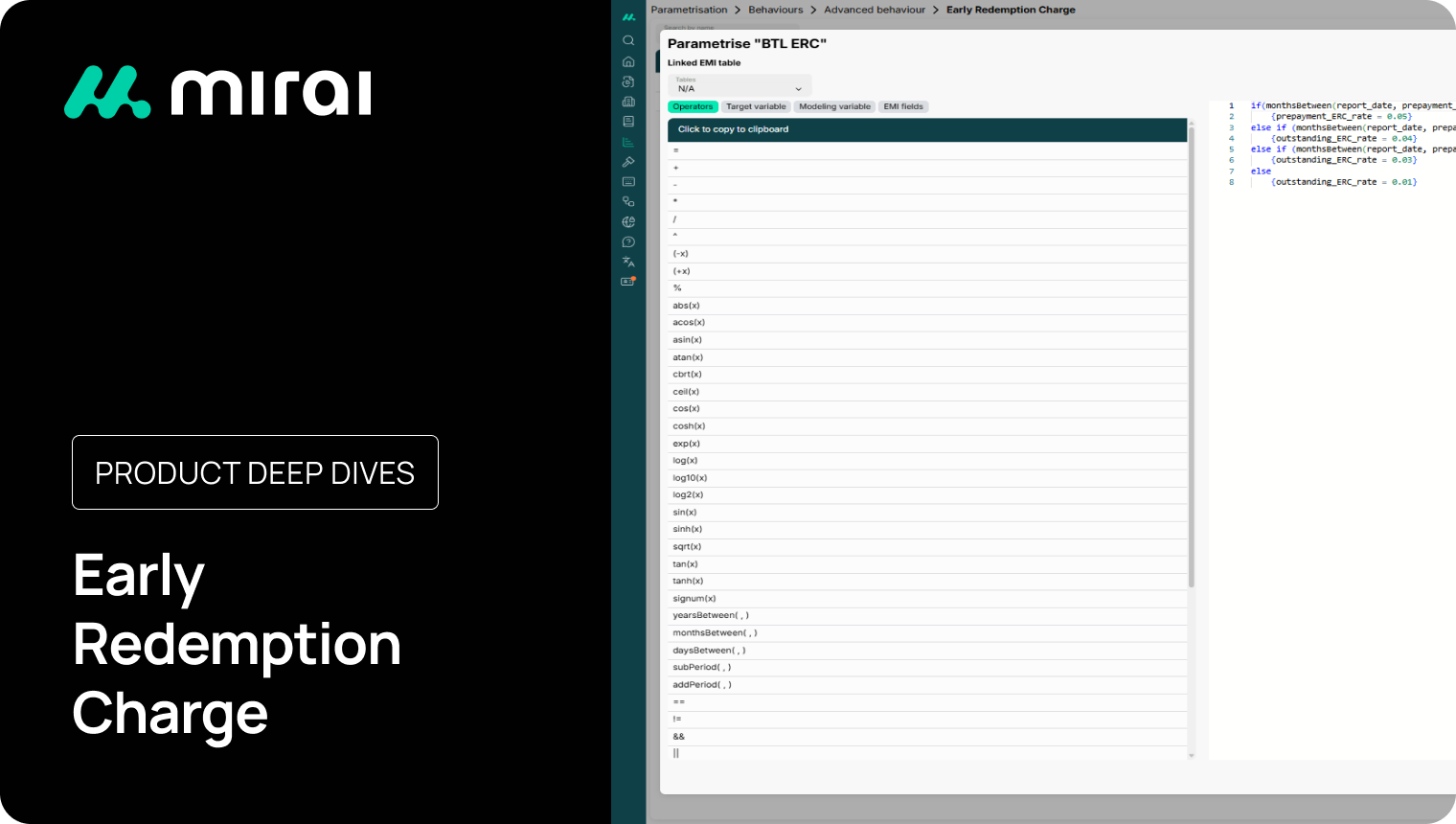


Early redemption or repayment is a common reality in financial products, from mortgages to loans and deposits. However, it introduces revenue uncertainty. Mirai’s Early Redemption Charge (ERC) capability enables institutions to model these effects consistently, transparently, and with full flexibility.
Built as an advanced behavioral model within Mirai, ERC allows users to define dynamic fee policies applied to prepayment/redemption events, using the same governed framework as all other behavioral assumptions. This ensures that fee modeling is no longer an external or manual adjustment, but a fully integrated part of cash flow generation and valuation.
What Is ERC?
At its core, ERC enables institutions to capture the financial impact of early repayment through configurable rules that can reflect product characteristics, customer behavior, or market conditions.
Rather than relying on static assumptions, users can define fee structures that:
-
Adapt to product types (e.g., fixed vs. floating)
-
Evolve over the life cycle of the contract
-
Leverage external modelling inputs (EMI) for richer segmentation
-
Integrate seamlessly with prepayment and other behavioral models
The result is a more realistic representation of cash flows, especially in scenarios where early repayment risk is material.
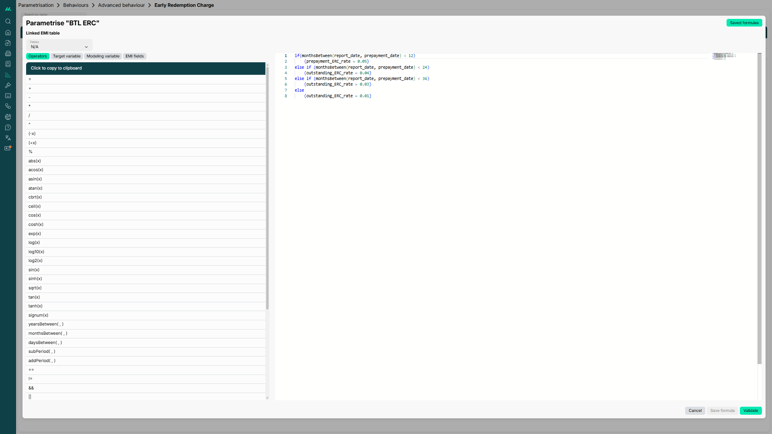
As with the rest of the behavioral models, it uses the formula builder and can draw on EMI tables/parameters to make the fee policy dependent on external modelling variables.
Parameterization
Follow these steps to make the most out of this functionality:
1) Choose your Fee Design (Event Based)
Decide whether the ERC will be percentage or flat per prepayment, and whether you’ll segment by product attributes or external data via EMI (e.g., fee tiers by product type, age bucket, market regime).2) Build the ERC Formula
In the formula builder, set your chosen target variable and express policy with conditions, arithmetic and, if needed, EMI lookups (e.g., different rates for fixed vs. floating, or age dependent fees using prepayment_date).
3) Assign the ERC to a Financial Behavior
Use the ERC box on the financial behavior to attach the model, then map that financial behavior to the product(s) where the fee applies.
4) Validate Outputs and Interactions
In results, erc_amount reflects the fee for each prepayment cashflow according to your formula. ERC integrates an advanced behavior, so it coexists with your prepayment/default models and flows naturally into valuation and cash flows.
Use Cases
Simple Fee on Prepayment Cash Flows
Apply 1% on each prepayment if the contract is floating, and 0.5% if fixed (target: prepayment_ERC_rate). Whenever a prepayment occurs, erc_amount is 1.0% or 0.5% × prepayment_cf; otherwise, it’s zero.
EMI Driven, Age Based ERC per Prepayment
Use an EMI table that stores ERC rates by age bucket and ERC Type (e.g., Type 1/2/3). Provide the ERC Type through a contractual EMI parameter (e.g., emi_param_04). In the formula (target: prepayment_ERC_rate), the fee for each prepayment depends on: (a) whether the contract is new business or runoff, (b) its ERC Type, and (c ) the contract age in months, computed relative to prepayment_date. At runtime, the model selects the correct rate for the current prepayment period and computes erc_amount = rate × prepayment_cf.
Final Overview
ERC brings fee policy under the same governed, formula based framework as your other behaviors: choose event based vs periodic charging, define one of four target variables, and (optionally) use EMI for data driven tiers across product types and ages. Because the behavior plugs directly into Mirai’s execution flow, fees appear transparently as outputs and remain easy to audit, explain, and iterate, without custom code or manual post processing.