Book a Demo




Fund transfer pricing exists to answer a very relevant question: what does it actually cost the institution to fund each product, client, or business line? Does the margin we are obtaining justify that cost? That figure, correctly calculated, is the foundation on which a financial institution's balance sheet strategy is built: which products to promote, which margins are real and which are illusory, where growth makes sense and where the cost of funding makes an operation unviable.
Today, not all large banks have an FTP framework in place, and very few have one that their CFO, Head of Treasury, and Head of Finance would describe in the same way.
This matters because in a G-SIB, the difference between a well-implemented FTP process and a deficient one is not measured in operational efficiency, it is measured in the income statement. Pricing and capital allocation decisions made on the basis of inaccurate or outdated rates distort the institution's true net interest margin. A properly functioning FTP turns margin into a reliable signal; a poorly calculated one turns it into a problem.
A Critical Process That Demands Daily Execution
Institutions that extract the most value from their FTP share one characteristic: their FTP framework is not an isolated process. It is connected to balance sheet management, liquidity, regulatory reporting, capital, and the P&L. When those connections are absent or manual, FTP ends up explaining the past rather than informing the future.
For an institution's FTP to be accurate, a robust system such as Mirai FTP & Profitability is required, one that ensures:
Governance and cross-functional consistency
Finance, treasury, risk, and planning teams must be aligned on how transfer rates are calculated and how they are used for P&L attribution. In many cases, different methodologies, inputs, or assumptions produce different results for the same transaction depending on which team performs the analysis. Mirai resolves this by running FTP on the same calculation engine, the same data, and the same assumptions across all areas of the institution, so that the same transaction produces the same result regardless of who is analyzing it.
Data quality
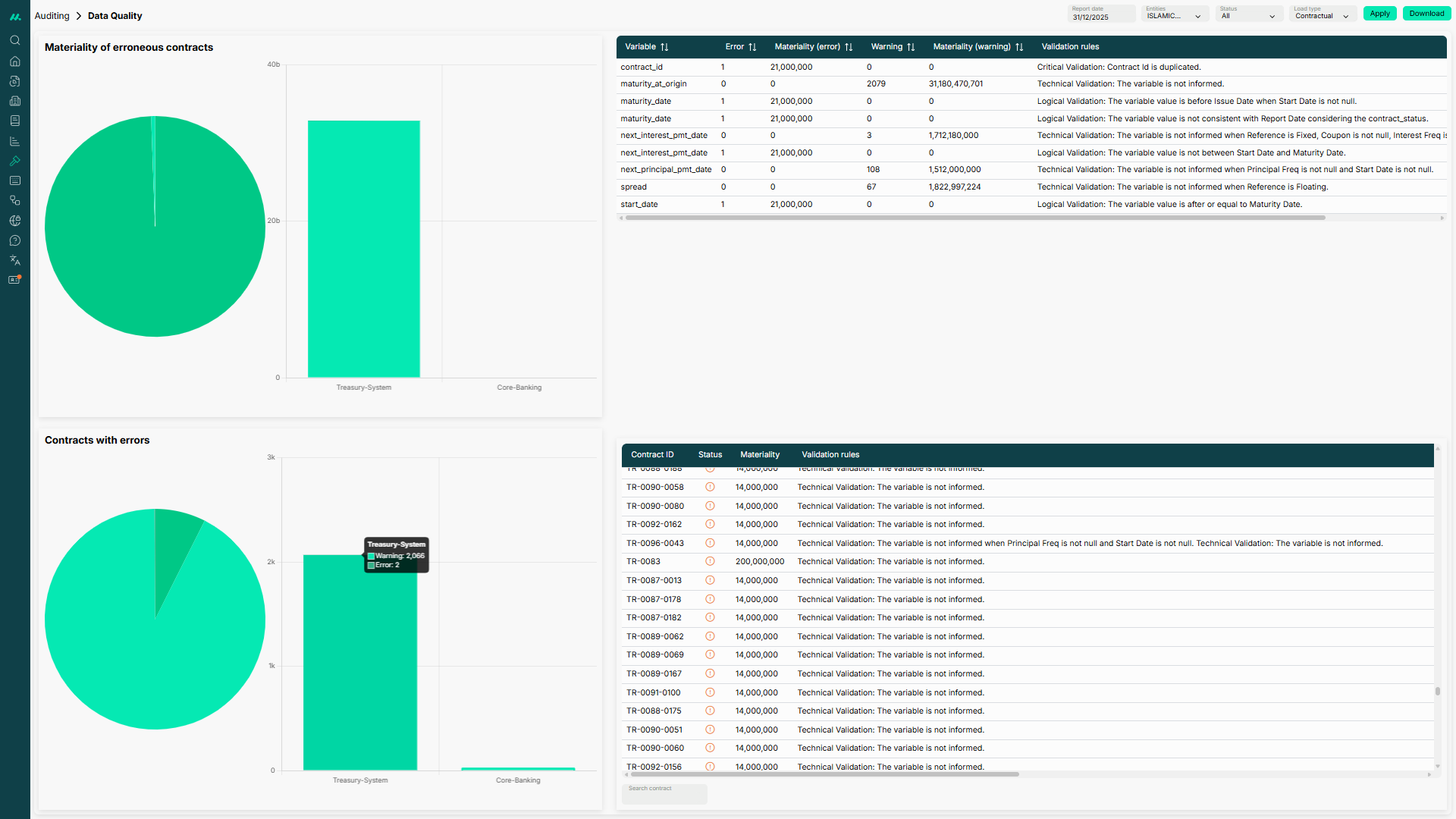
An FTP rate is only as credible as the contractual data underpinning it. Reliable contractual data, shared across all areas of the institution and ensuring traceability, consistency, and precision, is therefore essential to FTP calculation. Regulators and auditors expect an immediate, complete answer about the origin of a number, not a reconstruction exercise. Before any contract reaches the models, Mirai subjects it to a validation layer that checks incoming data against a set of critical, logical, and technical rules. Errors are identified instantly, with type and status flagged for resolution. Only clean data reaches the calculation engine.
Contract-level granularity
A portfolio-level FTP built on averaged funding costs by product group conceals the true economics of each contract. It cannot identify which specific clients generate economic value after all funding, liquidity, and capital costs, and which do not. That is the basis of pricing strategy, client segmentation, and resource allocation. In Mirai, rates are calculated contract by contract, assigning each transaction a funding cost and a credit based on its cash flow profile, maturity, repricing characteristics, and optionality.
Daily execution
FTP has ceased to be a periodic exercise and has become a daily business process. Market conditions shift every day, new production enters the balance sheet continuously, and business units need up-to-date rates so that their pricing decisions reflect the actual cost of funding at that moment. Operating on data that is a week old in an environment that changes daily is equivalent to managing the balance sheet with stale information. At G-SIB scale, that lag is amplified.
Forward-looking capability
The ability to analyze margin impact before a decision is made, not after, is what separates a functional FTP framework from a strategic one. Manual processes and disconnected systems make that impossible at the speed required.
This combination of daily frequency, granularity, and auditability requirements is precisely what makes a robust, fully autonomous system necessary. It is neither viable nor safe to rely on manual processes to produce critical information of this nature on a daily basis. The volume of contracts, the complexity of the models, and the need for auditability mean that any human intervention in the process is a point of friction that will, sooner or later, generate errors, delays, or audit gaps. Automation is not an efficiency improvement. It is a reliability requirement.
Methodological Foundation: Auditable Models Adapted to Each Institution
Before discussing automation, the methodology must be right. An automated process that replicates incorrect calculations solves nothing. The institution needs models that respond to its specific balance sheet requirements, flexible enough to accommodate every product scenario, and at the same time fully auditable and traceable back to the methodological documentation.
This means that each product and each spread component requires its own treatment. The liquidity premium on a demand deposit is not modelled in the same way as that on a fixed-rate mortgage. Behavioral assumptions for products without contractual maturity cannot be applied generically. The model architecture must be granular:
-
Funding curves differentiated by tenor, currency, and product type.
-
Decomposition of the spread into its individual components: base funding cost, liquidity premium, optionality, and so on.
-
Full traceability of every parameter, so that any rate can be explained and independently validated.
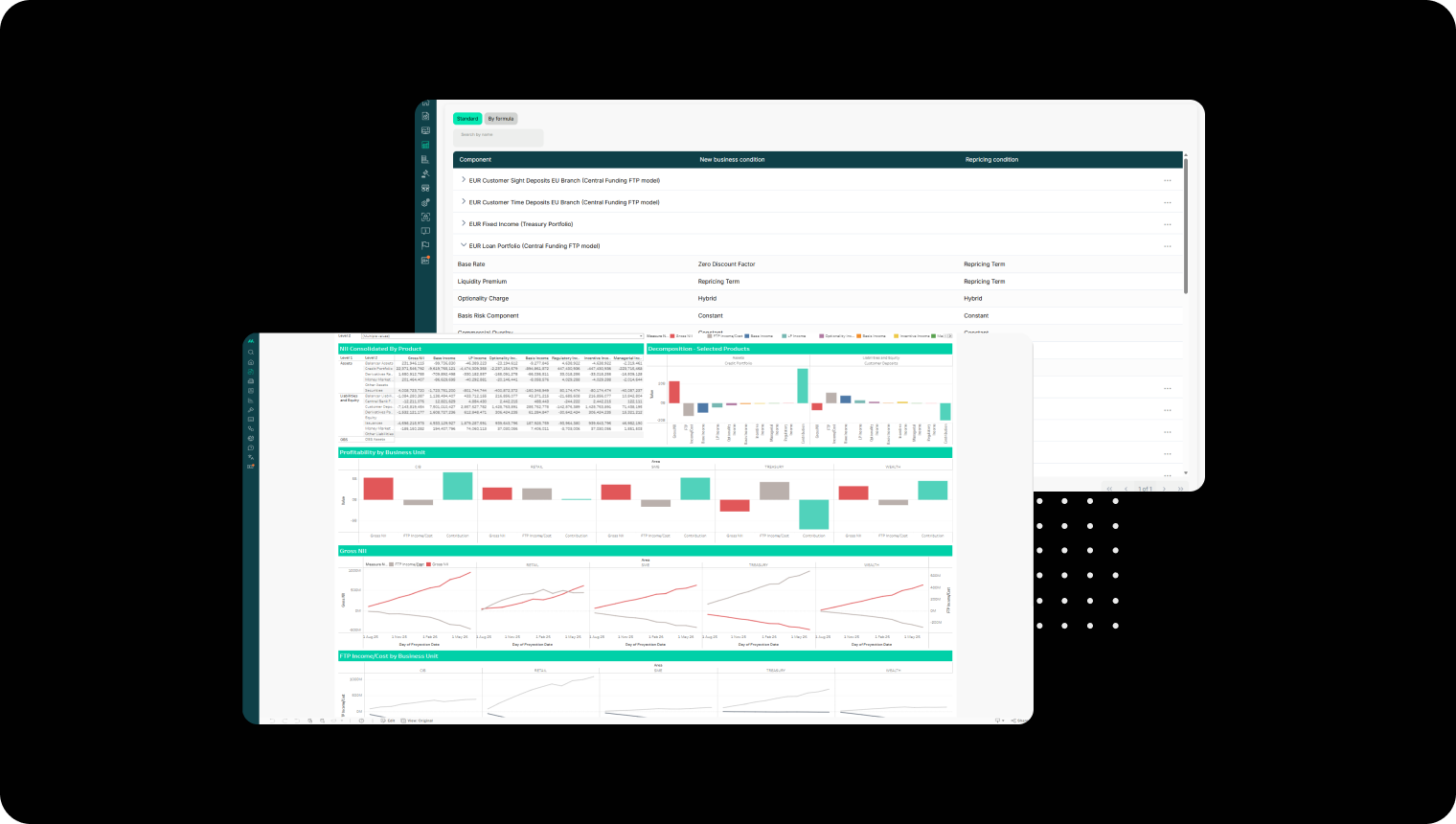
Mirai supports a broad range of calculation methodologies, including cash flow-based methods such as zero discount factor, weighted term, and weighted average life, as well as non-cash flow methods such as repricing maturity, moving average, and hybrid models. Method assignment can be configured by product, currency, segment, and branch. Spreads, including base curve, liquidity premium, credit spread, and regulatory cost, are applied separately and are visible, explainable, and consistent across all business lines.
This methodological foundation is what gives credibility to the number that reaches the business. FTP rates that business units do not trust are ignored; those that are traceable and consistent are used to make real decisions.
Fully Automated Process: From Data Load to Repository Without Intervention
For information to be available first thing each morning, the process must be automatic, fast, and accurate. This is not simply about eliminating manual work, it is about ensuring that when teams arrive, the prior day's data has been calculated, validated, and loaded, without anyone having had to launch or supervise anything overnight. The absence of user intervention is not a convenience; it is the condition that ensures the cycle closes without failure and on time. Mirai covers the entire process, from data load to delivery to the institution's repository.
The process runs in four phases:
-
Data load: Position and contract data is loaded automatically in a nightly batch process. No user intervention is required at any point during the load.
-
Scenario execution: Once the data is loaded, a trigger fires and launches the scenario based on previously defined assumptions. The calculation applies rates contract by contract, disaggregates spreads by component, and projects forward metrics across the full simulation horizon.
-
Data export: Once the scenario is complete, the data is available within the platform and is extracted to the institution's systems and repositories for consumption. What is delivered is not a summary or a consolidated view: it is the complete set of metrics calculated for every single contract, with forward information for each date in the simulation horizon, at volumes exceeding 200 million records per run.
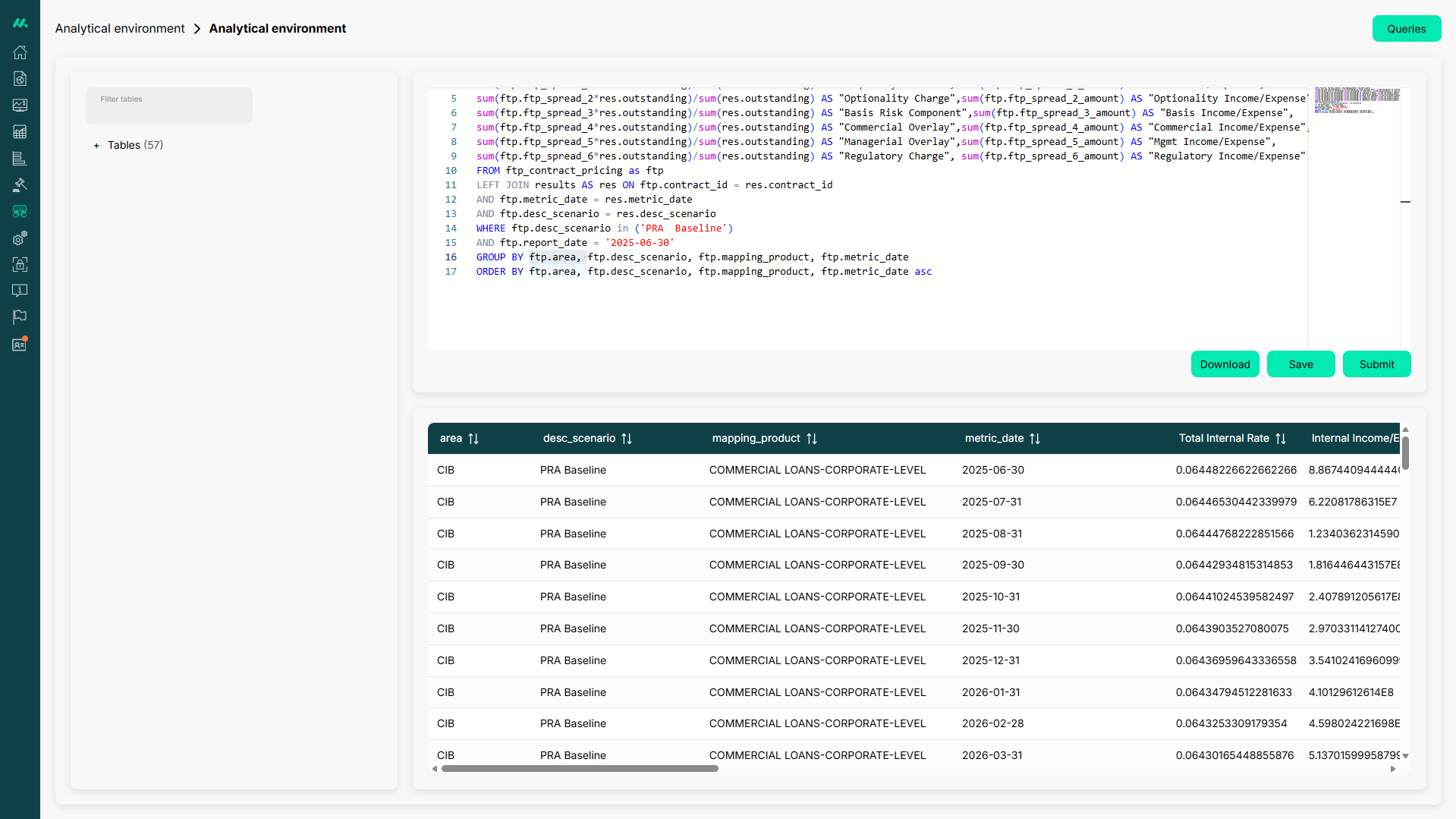
- Information exploitation and reporting: The institution has access to all FTP rate calculations for every contract, at the maximum level of granularity, ready for analysis and reporting from the start of the day. Mirai includes an integrated query environment that allows teams to build, save, and run their own queries across any dimension and download results on demand, without depending on ad hoc extracts.
The daily process is a completed fact, not a pending task.
Analytical Capability Without Limits
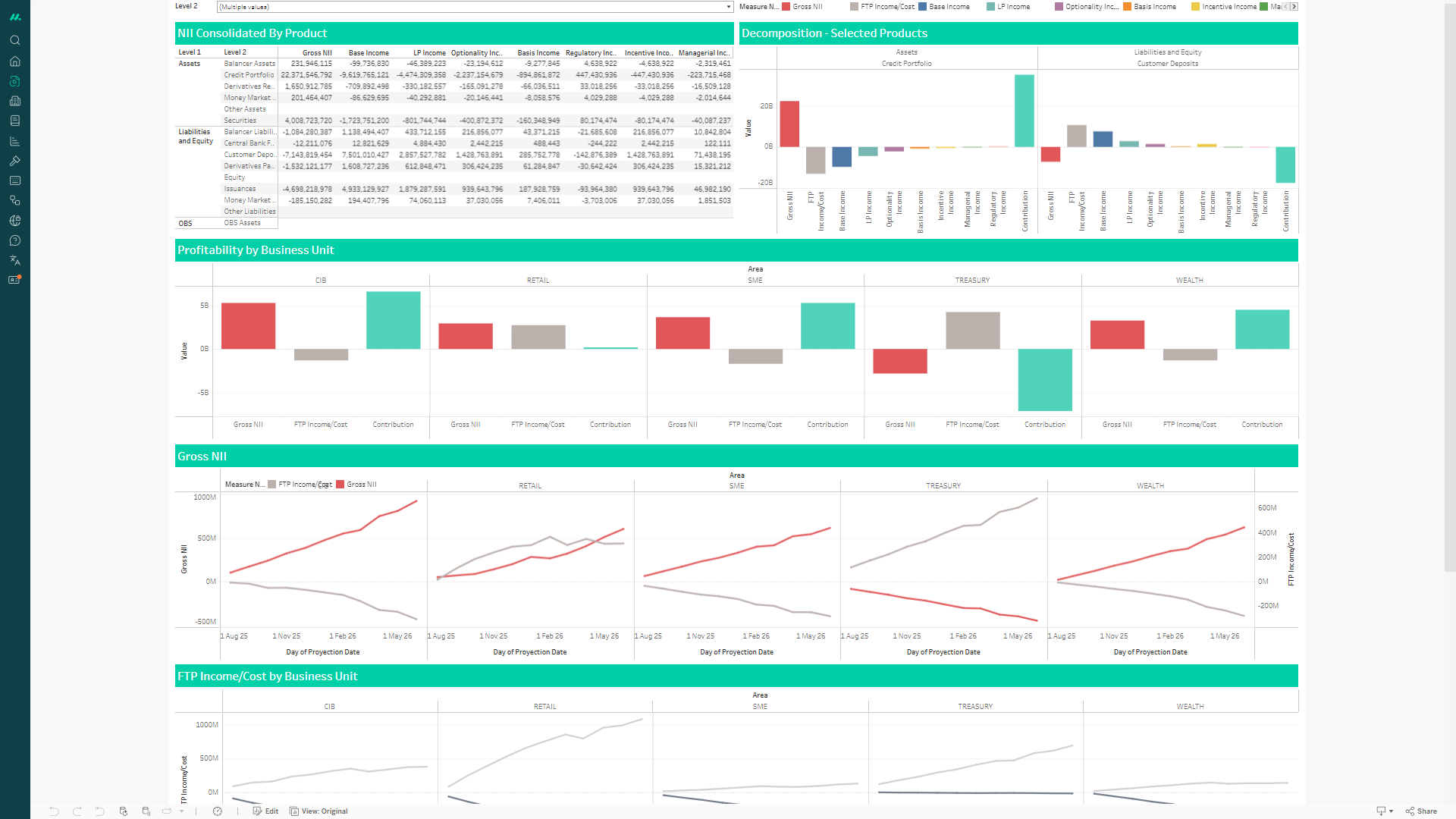
Granularity of data is what turns FTP into a genuine management tool. With contract-level information for every forward date in the simulation horizon, analysis can be performed at the maximum level of detail or consolidated across any dimension relevant to the institution:
-
By legal entity, business area, branch, or cost center
-
By geographic location or any other segmentation axis defined by the client
-
By product type, currency, tenor, or spread component
All historical data is retained without any age limitation. This makes it possible to review any past date, compare spread behavior across different points in the cycle, analyze the evolution of the funding cost of a specific portfolio, or audit a rate applied to any contract at any point in time. There is no retention window that forces the loss of context.
The result is that treasury, finance, and risk all work from the same database, with the same level of detail, without depending on ad hoc extracts to answer specific questions.
Business Value: Decisions Based on Real Information
The combination of a fully autonomous process with daily, granular data changes how an institution can operate its balance sheet.
From an operational standpoint:
-
The automated process runs without user intervention, eliminates dependence on teams to launch or supervise calculations, and reduces to zero the operational risk associated with manual management.
- Every run generates a complete auditable record, which facilitates any subsequent methodological or regulatory review.
From a business standpoint:
-
Business units receive updated FTP rates every day, ensuring that pricing decisions reflect the actual cost of funding at the time they are made.
-
Management has a view of net interest margin that deducts the real cost of liquidity, not an estimated or lagged one.
-
Methodological or curve changes propagate immediately and consistently across the entire portfolio, with no risk of inconsistencies between portfolios or business lines. When methodology or curves change in Mirai, the update flows immediately and consistently through the entire portfolio, across all business lines and legal entities, without the need for manual reconciliation.
At G-SIB scale, having daily access to information at that level of detail is not a one-off competitive advantage. It is the difference between managing the balance sheet with real visibility and doing so with approximations.

Curious to see it in action? Watch the video!