Book a Demo


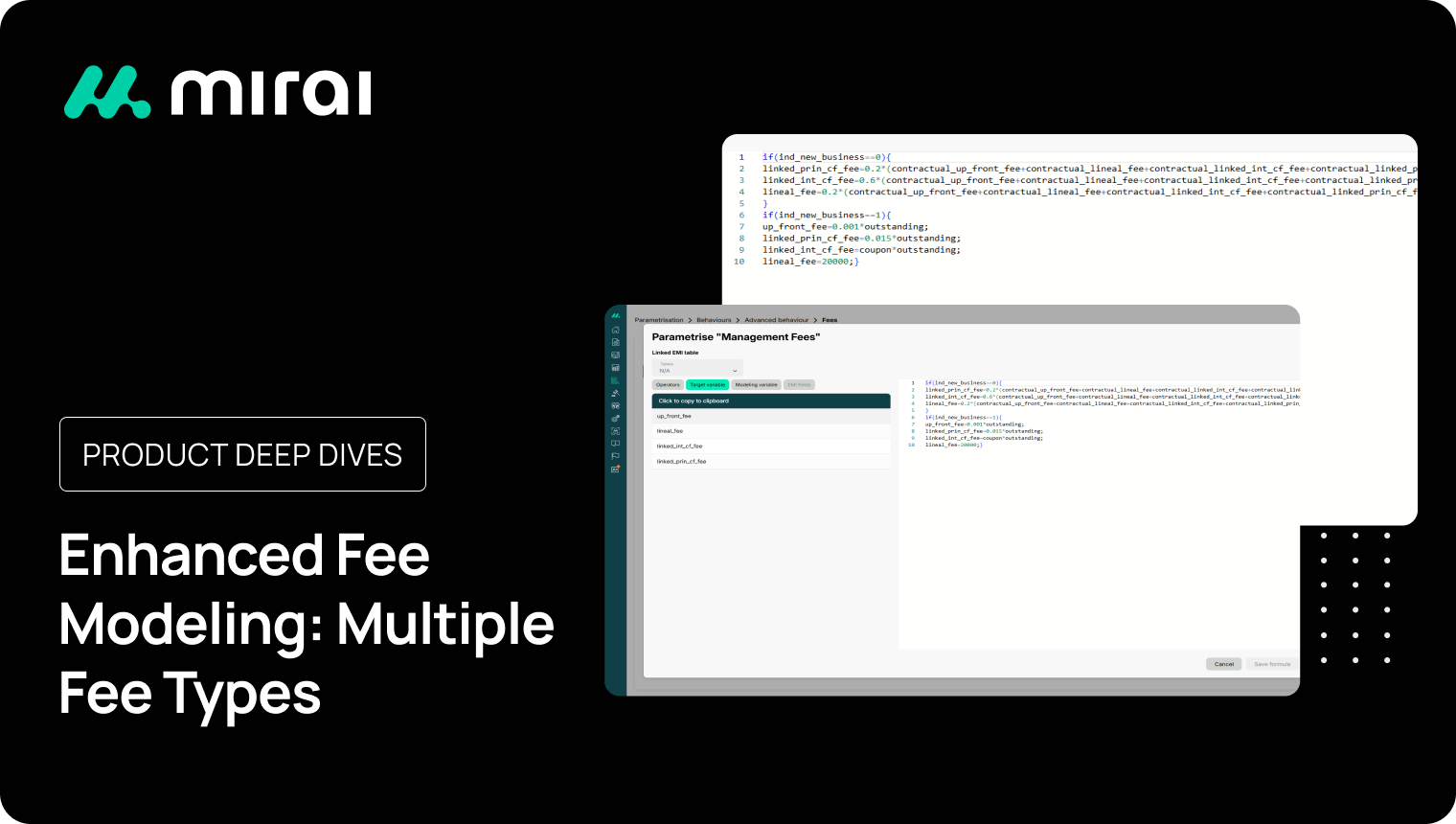


Fee Modeling extends Mirai's capabilities to support four additional commission categories: upfront, lineal, interest-linked, and principal-linked fees. Fees can be entered contractually or built through advanced formula logic, and are fully integrated across run-off, new business, and what-if scenarios.
Why It Matters?
Mirai incorporates powerful fee modeling capabilities, enabling banks to include a broader range of fee types, such as upfront, linear, and cashflow linked commissions, directly within their balance sheet products.
Designed to enrich profitability modeling and strengthen product accuracy, this functionality allows institutions to capture real world fee structures with greater precision.
By expanding existing capabilities to support additional fee families, Mirai more accurately reflects contractual pricing and revenue structures.
This unified approach unlocks a flexible modeling framework capable of accommodating all standard and advanced fee behaviors, ensuring that product economics are represented holistically and consistently across run-off and new business portfolios.
How It Works
Fee Modeling operates through two complementary approaches. Fees can be entered directly as contractual terms using the newly introduced fields, or modeled dynamically through Mirai's formula builder, giving institutions the flexibility to reflect both standard and complex fee structures across their portfolios.
The platform supports four new fee types: upfront, lineal, interest-linked, and principal-linked, alongside existing commissions such as penalty fees and early redemption charges (ERC).
Beyond contractual inputs, Mirai includes a new Fee behavior configuration screen that allows users to model fees dynamically using formulas. Users can rely on modeling variables, custom financial indicators and tables, yield curves, or contractual fee parameters (applicable to run off only) to shape fee logic. This flexibility means fee behavior can embody contract type, interest structure, or any behavioral characteristic.
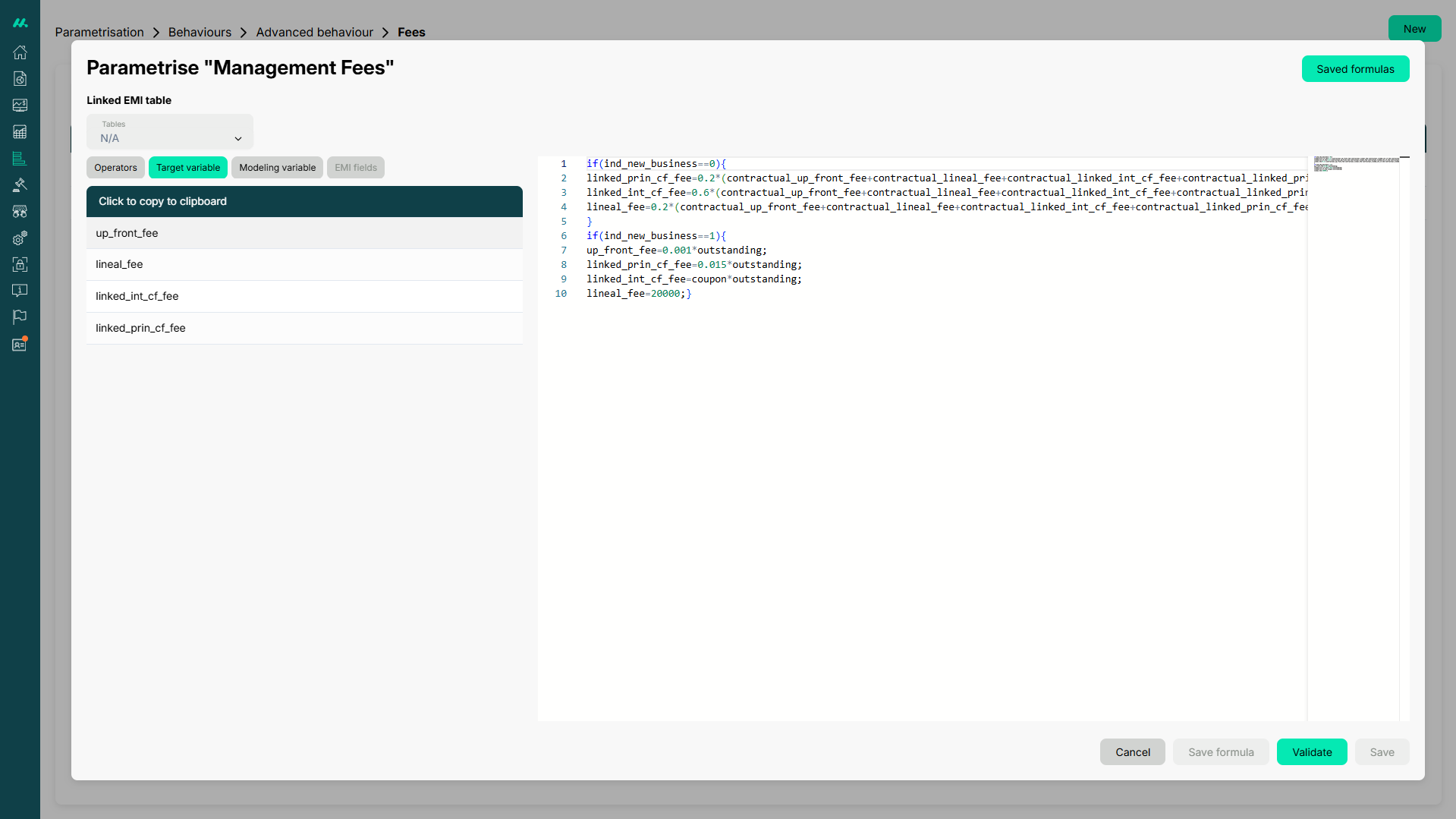
The feature operates through a synergy of contractual inputs, advanced formula logic, and enhanced output structures, allowing banks to model all fee types accurately throughout a contract’s lifecycle.
Four New Types
Mirai’s expanded fee framework introduces four distinct commission categories:
-
Upfront Fee: Applied at the contract start.
-
Lineal Fee: Accrued evenly throughout the contract term.
-
Linked Interest Cashflow Fee: Accrued proportionally to interest payments.
-
Linked Principal Cashflow Fee: Accrued proportionally to principal amortization.
Advanced Modeling Capabilities
The Fee behavior expands Mirai’s modeling versatility. Within the formula builder, users can:
-
Model each fee type individually or collectively.
-
Use custom time series data of financial indicators or other relevant dimension tables/parameters for market driven fee logic.
-
Apply conditional logic based on contract attributes (e.g., fixed vs floating).
-
Construct hierarchical structures to reflect complex institution specific fee rules.
Enhanced Output & Metrics
The analytical capabilities in Mirai allow to segment the fee income into each of its specific fee types for a more robust understanding of the drivers of the income statement. This empowers risk, finance, and ALM teams to analyze profitability with greater depth and accuracy.
Use Cases
The following examples demonstrating conditional logic and differentiated behavior between run off and new business, show the strength and flexibility of the new fee logic.
Tiered Fee Structure for Fixed vs Floating Loans
A bank wants to introduce different fee profiles depending on whether a loan is fixed rate or floating rate.
Using Mirai’s advanced Fee behavior:
-
The formula begins by identifying whether the contract is run off or new business.
-
For run off contracts, contractual fee amounts may be used as inputs to calculate commission levels more precisely.
-
For new business contracts, the formula avoids contractual variables and instead computes fees based on the business dimension rules.
-
Within each branch, fixed rate contracts may use higher upfront fees but lower lineal fees, while floating rate contracts may apply higher interest linked fees due to variable performance over time.
This hierarchical setup enables institutions to reflect product specific fee strategies without manual intervention.
Advanced Hierarchical Fee Calculation
The second example highlights a more sophisticated logic in which fee modeling incorporates multiple decision layers: contract type, business segment, rate regime, and more. For instance:
-
Run off fixed rate loans may prioritize upfront and lineal fees.
-
Run off floating loans may emphasize interest linked and principal linked fees.
-
New business flows may use simplified fee rules based solely on product category.
This empowers users to replicate real world fee policies used across mortgage, consumer lending, SME lending, or corporate banking portfolios, without having to build separate behaviors for each category.
Final Overview
Mirai’s enhanced Fee Modeling feature represents a major evolution in how banks can reflect the true economics of their products. By supporting four new fee families and offering both contractual and formula driven modeling, Mirai empowers institutions to treat fees with the same depth, flexibility, and analytical precision as interest or behavioral assumptions.
Integrated across run off, new business, and what if scenarios, this feature strengthens profitability insights and ensures that fee income is accurately captured in NIM, performance metrics, and strategic planning.