Book a Demo


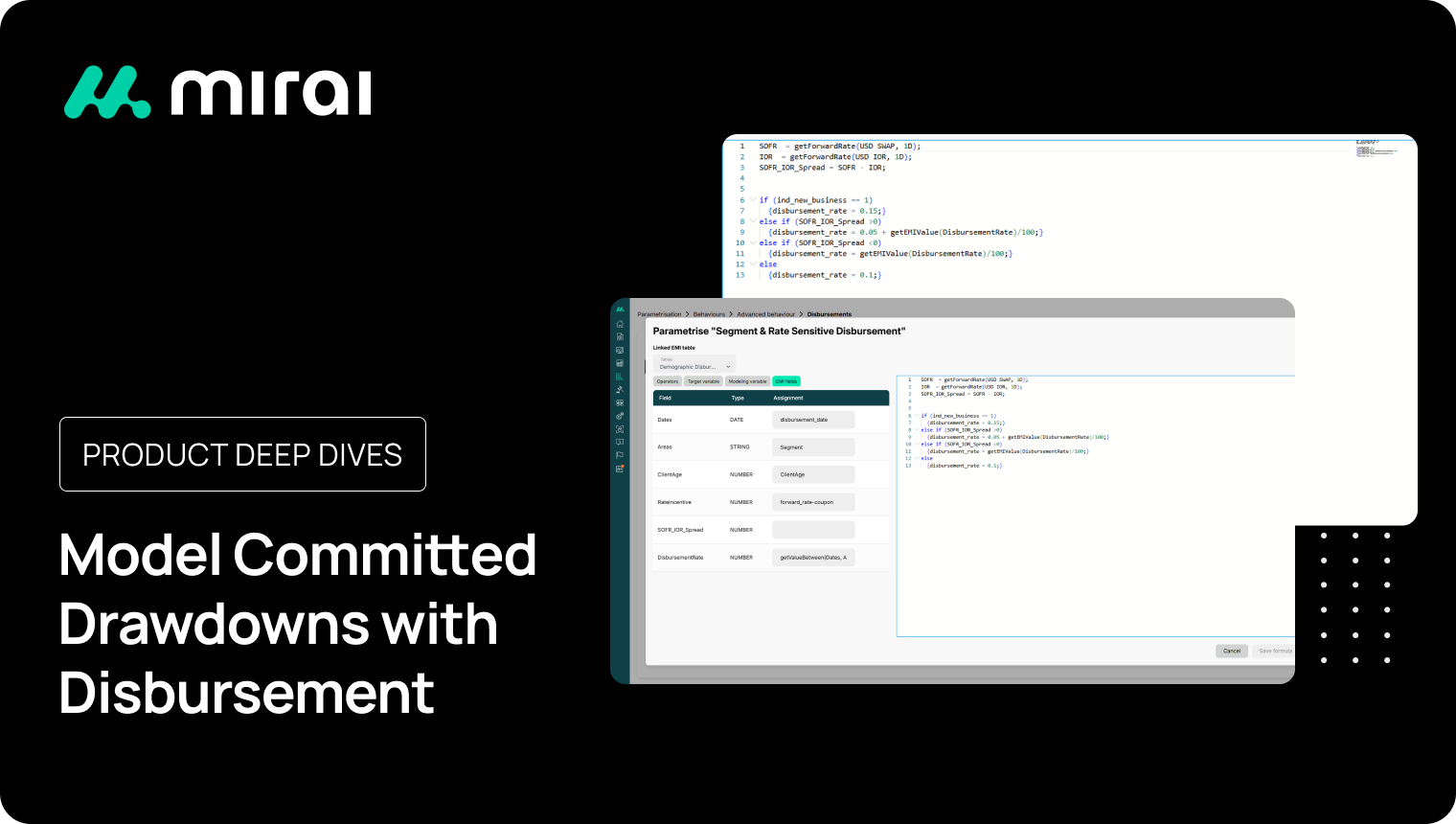


Disbursement is a behavioral model in Mirai that captures how customers access committed-but-undrawn funds over the life of a facility. Rather than assuming a loan is delivered in full at inception, Disbursement lets you reflect the reality that funds are often drawn gradually, and ensures those movements flow automatically into your balance evolution, cash flows, and ALM metrics.
What Is Disbursement?
Disbursement models a client's access to committed funds not disbursed at the start of the loan, enabling more realistic balance evolution and cash-flow timing. It is configured as an Advanced Behavior on Bullet, Level, or Straight Line financial behaviors, alongside the other behavioral models you already use.
Parameterization
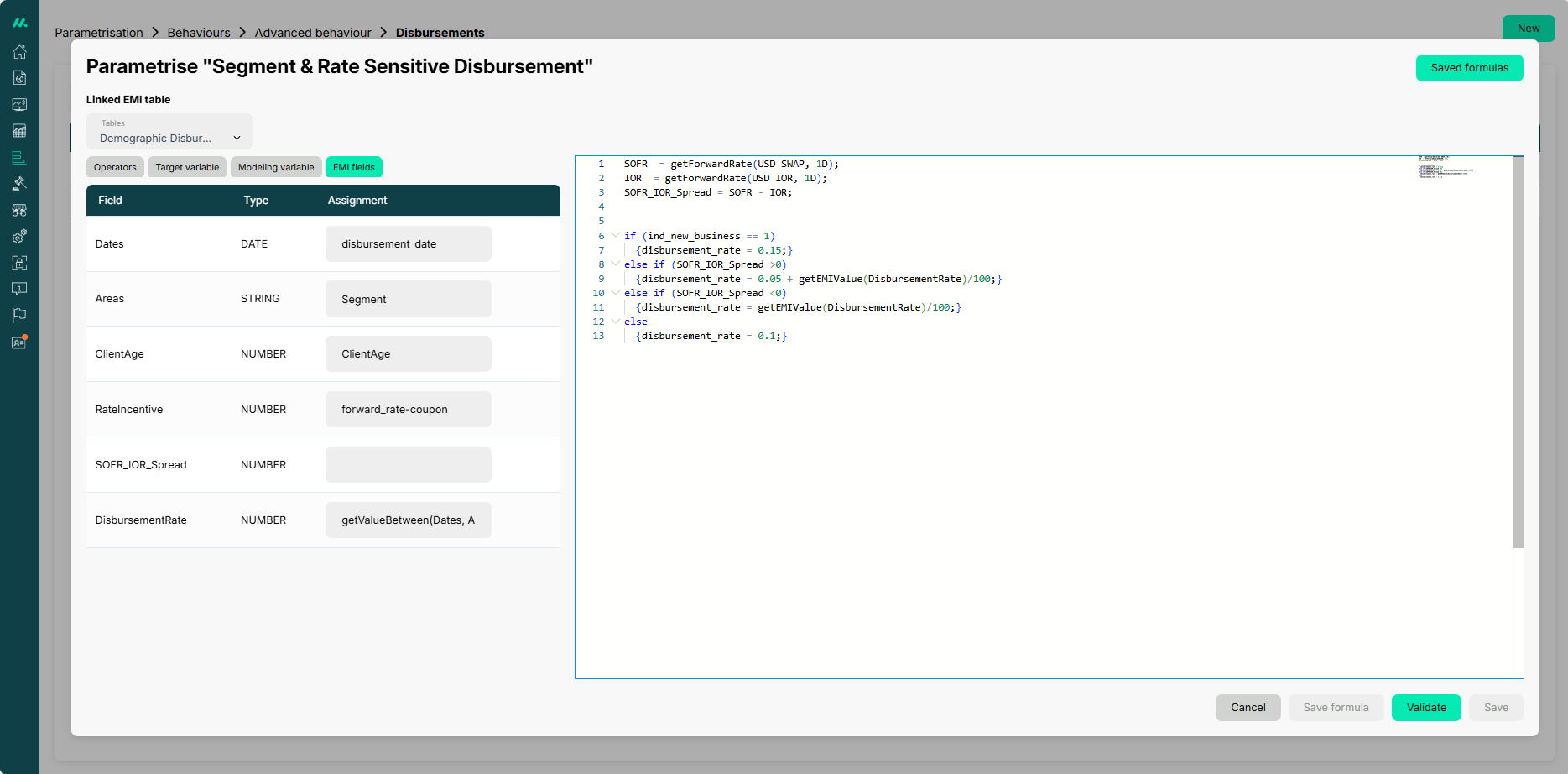
Disbursement is built with Mirai's formula editor, just like Prepayment-by-formula or Default-by-formula. This means drawdown behavior can be as simple or as sophisticated as your policy requires, from a constant utilization rate to rules that respond to external drivers and contract attributes. Because the logic is expressed through the same formula environment and data interfaces you use elsewhere, it stays transparent and auditable throughout the simulation.
Disbursement Workflow
Follow these steps:
1) Start with the Input Interface
Load the available_amount for each contract (the undrawn commitment at report date). You can also rely on the usual contractual attributes (e.g., outstanding, coupon, forward_rate, report_date, start_date, maturity_date) and the EMI parameters to segment behaviors if needed.
2) Define the Disbursement formula & Link the behavior to the product/contract
In the formula builder, set disbursement_rate using constants, conditions, EMI lookups, or drivers like tenor/age via disbursement_date. This determines the portion of remaining available_amount drawn each date.
3) Validate outputs
Review Disbursement_amount and Undisbursement_amount in the analytical tables to ensure the pattern matches policy; confirm that outstanding/book evolve as expected with other behaviors (prepay/default).
Use Cases
Simple Constant Model
At its simplest, Disbursement releases a fixed portion of the committed line at each date until the facility matures or the undrawn balance reaches zero. Each release increases the outstanding balance and, for Level and Straight Line behaviors, prompts a recalculation of amortization so the loan still finishes at maturity.
Segment, Age & Rate Sensitive Disbursement
More advanced models let drawdown behavior respond to the things that actually drive utilization: customer segment, the age of the facility, and whether market conditions make drawing attractive. A policy can lean on portfolio segmentation, taper utilization as a facility matures, and scale up when refinancing conditions are favorable, all bounded for stability.
-
Base rate lookup (EMI): The model links to an EMI table whose key columns include Dates and Areas (segment). It retrieves a base Disbursement Rate for the current disbursement date and segment, using a table lookup in the formula.
-
Rate incentive signal: It computes an incentive term from forward rate – coupon so that, when refinancing conditions are favorable, the monthly disbursement rate can scale up; if the incentive is negative, it’s treated as zero.
-
A spread (e.g., SOFR_IOR_Spread) is introduced as an additional adjustment knob, it can be used as a proxy of liquidity conditions in the market (sourced either from the EMI table or as an intermediate formula result) and can nudge the base disbursement rate up or down by tenor, date, or policy.
-
Client age modulation: Using ClientAge (years since start date to disbursement date), the formula applies age buckets to taper utilisation over time (e.g., higher in early life, lower later on).
-
Bounds for stability: The computed disbursement rate is floored at 0 and capped by a business limit to avoid spikes; the resulting Disbursement_amount is then added to book value and outstanding at month end, feeding cashflows and subsequent behavior models.
The result is a policy-driven, auditable rule that changes smoothly with both market conditions and customer demographics. It operationalizes a realistic principle: draws depend on who the customer is, how old the facility is, and whether rates make drawing attractive, while keeping everything governed through formula and data interfaces and fully visible in Mirai's outputs.
Final Overview
Disbursement brings committed-but-undrawn reality into your models: you set how and when customers access funds, Mirai updates balances and cash flows accordingly, and outputs surface both drawn and remaining amounts. It supports all amortization types, coexists with default, prepayment, and elasticity logic, and is governed through the same formula editor and data interfaces you already use, so you can express business policy cleanly, audit it, and iterate without custom code.