Book a Demo





A treasurer who needs term funding may have three ways to issue it, at different rates and different maturities. Each option changes what the bank pays for its money, how long the funding stays in place and where the regulatory ratios end up. The treasurer has to know which option leaves the best margin, and what each one does to the ratios, before the issue is priced.
The rate cycle of 2022 and 2023 showed how quickly margins move when rates do, and how hard it was for many institutions to say how much of their rising net interest income (NII) came from commercial activity and how much from the level of rates. That uncertainty weighs most on decisions the bank has not yet taken.
This article examines what-if strategies built on funds transfer pricing (FTP): how a bank can test a debt issuance or a deposit campaign against its projected real margin and its regulatory ratios in the same run, why that test needs one set of assumptions, and how the result turns into action.
A Funding Decision Is Also a Margin Decision
FTP sets, for every loan and deposit, the real cost the money has for the bank: its FTP rate. The FTP rate is a base rate taken from the yield curve plus FTP spreads that each institution defines for itself. A liquidity spread, an optionality spread and a regulatory spread are one example of such a set, and other institutions cut theirs differently. The rate the bank applies minus the FTP rate is the contribution margin, which is what this article means by the real margin.
This definition explains why an issuance reaches well beyond treasury. Each option changes the bank's cost of funding, and therefore the contribution margin left on the business it finances once FTP has charged that cost through. The issuance moves the margin of products the treasurer does not sell, in branches the treasurer never visits.
It also moves the liquidity position and the regulatory ratios. A shorter issue may come cheaper but has to be refinanced sooner, while a longer one usually costs more and secures the funding for longer. The option with the best margin and the option with the strongest ratios need not be the same one, and the bank has to see both before it chooses.
A decision with two outcomes needs both of them measured on the same basis.
Why Separate Estimates Do Not Settle the Choice
In many institutions, the options would be assessed in pieces. Treasury estimates the funding cost, finance the effect on income and regulatory reporting the ratios, each in its own environment and often on its own assumptions. The decision becomes a negotiation between partial estimates rather than a comparison of complete outcomes.
The assumptions are where the pieces drift apart. The interagency guidance on FTP issued by the Federal Reserve, the Federal Deposit Insurance Corporation (FDIC) and the Office of the Comptroller of the Currency (OCC), known as SR 16-3, asks firms whose FTP assumptions differ from those used in their liquidity stress testing to document the inconsistencies. If the FTP curve assumes a block of current accounts stays for years while the liquidity stress test assumes much of it leaves within weeks, the margin and the liquidity position describe two different banks. As non-maturity deposits explained shows, one deposit assumption reaches liquidity, interest rate risk and FTP at once.
Reconciling the two takes time. By the time the numbers agree, the issue has usually been priced.
The Real Margin Has to Exist Before It Can Be Projected
A what-if strategy projects the real margin forward, so it depends on having that margin today, contract by contract. Where FTP runs by hand in spreadsheets, on simplified curves and assumptions, the margin arrives approximate, averaged and late. Álvaro Nieto, Head of Product at Mirai, describes the limit of that approach in plain terms:
A manual process carries too many assumptions. It is not fine-grained, it relies on simple methods, simple models and very basic simplifications, and it takes a long time.
A real FTP calculates the base rate and every FTP spread for every contract, on real yield curves, real behavioral assumptions and market-standard methodologies. At that scale it works only as a fully automated overnight process, described in what automated, contract-level FTP makes possible, from the source systems to the bank's operational systems, with no manual step in between. At one Mirai client, a global systemically important bank (G-SIB), the calculation processes millions of contracts in about 30 minutes.
This speed matters because the projection rests on the same calculation. FTP is applied to each contract and to each of its cash flows, and those flows run over the whole life of the contract, so the existing book already carries its future margin. A projection adds the new business the bank plans to book, the prepayments it expects and the path it assumes for rates. Measurement tells the bank where it stands; projection tells it where it is heading.
How Can Banks Measure the Real Margin Behind Every Loan and Deposit?
One Run, One Set of Assumptions
A what-if strategy applies that projected margin to decisions the bank has not yet taken. Each option runs through the same FTP calculation, on the same contracts and the same assumptions, and the output reports the projected real margin next to the option's effect on liquidity and regulatory ratios.
This single run depends on a single platform. The behavioral life of a deposit, the prepayment rate of a mortgage and the curve behind the base rate are defined once and used by every calculation, for management, for regulation and for FTP. Platforms such as the Mirai Platform bring FTP, balance sheet management and regulatory compliance together in this way, fed by one data load and run on one set of assumptions, so that the margin and the liquidity position describe the same bank.
Three Ways to Issue the Same Debt
Return to the treasurer. In a simple illustration, option A is a short issue at a lower rate, option C is a long issue at a higher rate that keeps the funding in place for years, and option B sits between them. These options describe the shape of the decision; they carry no market values.
Run through the what-if strategy, each option produces two results side by side. The first is the projected contribution margin on the business the funding supports, once FTP has charged the cost of that funding through to the contracts. The second is the option's effect on the liquidity position and the regulatory ratios, including the refinancing the shorter issue will need sooner.
Read together, the two results turn a funding choice into a visible trade-off. The cheapest issue may leave the best margin while doing least for the ratios; the longest may protect the ratios at a cost the margin has to absorb. The bank sees this while the issue can still be shaped, in its maturity, its size or its timing.
What a Deposit Campaign Really Costs
The same approach applies on the retail side of funding. A bank can compare different deposit-gathering options, such as campaigns at different rates or for different terms, and see the cost each would mean for the institution.
Deposit campaigns are easy to judge on volume, because new balances look welcome in the liquidity position from the first day. A term deposit campaign does improve that position, and FTP credits the deposit side with the funding value those balances provide. The rate paid to win them, however, lands on the same contribution margin. Set against that funding value, the comparison shows which campaign adds to the real margin and which only adds volume.
A campaign that pays more than the funding value its deposits earn buys balances at a negative contribution margin.
The Same Test Applies to Every Decision That Moves the Margin
The approach extends to every decision that moves the real margin:
- a change in the price of a product, such as the rate offered on 30-year mortgages
- a volume target for a product, business area or branch
- a shift in the product mix the commercial network is asked to sell
- a funding choice, from a debt issuance to a deposit campaign
Each of these moves the margin and the ratios together, which is why they have to be tested together. Nieto describes a client that did not charge its mortgages the regulatory cost of granting them, nor account for how each new mortgage affected its ratios, and that could end up granting a very high volume of them that turned out to be negative for the bank. A what-if strategy surfaces that outcome before the loans are granted.
From Result to Action
A simulation earns its place only when it changes what the bank does, and two of the actions that follow are direct. Products whose projected real margin is thin or negative are repriced, or their volume is limited, before more of them reach the book. Commercial effort is redirected toward the products, business areas and branches that earn most once the full FTP rate is counted.
A third action reaches further: objectives for business areas, branches and managers are set on the real margin rather than on volume or revenue. The Bank for International Settlements (BIS) Financial Stability Institute, surveying liquidity transfer pricing at 38 large banks, found bonus pools that were often a simple percentage of accrued revenue, with no regard for the liquidity risk taken. Targets set on volume push growth. Targets set on contribution margin push profitable growth.
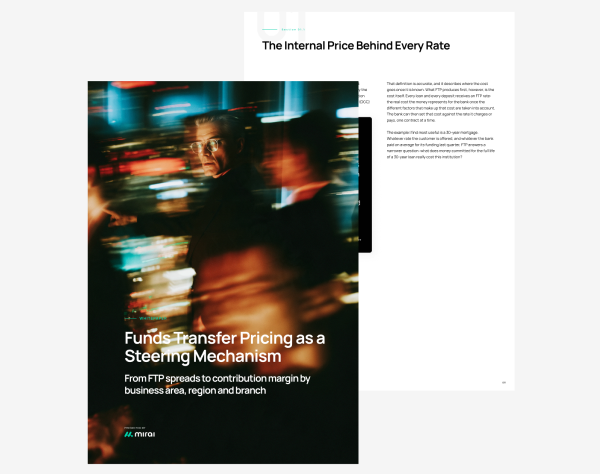
The whitepaper Funds Transfer Pricing as a Steering Mechanism shows how the same contract-level margin moves from measuring the past to steering decisions not yet taken, through four steps: measure, project, simulate and act.
Whichever way rates move next, reported margins will shift again. Institutions that test their funding and commercial decisions against the real margin will know which option to take before they commit; those that measure only after the fact will see the answer once the funding is already on the books. Nieto puts the case for the forward-looking step directly:
It is extremely important to have real metrics to measure the bank's real performance. But you can't stop there. You need a forward-looking approach: see how to optimize the real margin, which areas and products are profitable and which are not, and act on it.
For the full framework, from the base rate and FTP spreads to contribution margin by product, area and branch, calculated overnight and tested with what-if strategies, see Mirai RiskTech's whitepaper Funds Transfer Pricing as a Steering Mechanism: how banks measure and steer the real margin.